Exploring Organizational Learning and Knowledge Generation: Insights from Kogut & Zander
This article delves into the theories of organizational learning and knowledge generation, drawing on the foundational work of professors Kogut and Zander. It combines insights into organizational design, innovation, and competition, highlighting their contributions to understanding how knowledge flows within and between organizations. The text also references key themes such as organizational change, adaptation, and memory, emphasizing the dynamic interplay between information distribution and actionable knowledge in organizations. Ultimately, it targets advancements in knowledge management and innovation practices.

Exploring Organizational Learning and Knowledge Generation: Insights from Kogut & Zander
E N D
Presentation Transcript
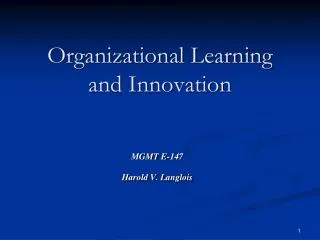
Organizational Learning and Knowledge Generation Kogut & Zander Hedlund Huber Sven Thoms MIS 580 October 20, 2005
Kogut & Zander • Kogut: Professor of International Management at Wharton B-School - Organizational Design, E-Business, Competition • Zander: IIB Stockholm Professor, Innovation and Entrepreneurship • Organizational design and innovation research combined in article
Hedlund • Was Director of Institute of Institute of International Business at Stockholm • European Institute of Japanese Studies • Spent time at Wharton Kogut • Died of illness in 1997 • 1993 article with Nonaka on Models of Knowledge Management in the West and Japan • Builds on individual, group, organization, network perspective Kogut and Zander introduced
Huber • Organizational Change and Redesign at University of Texas, Austin • Book 1993: The Necessary Nature of Future Firms - Attributes of Survivors in a Changing World • Topics: Organizational Change, Learning, Adaptation
Kogut, Zander, HedlundRelated Themes • Combinatorial Chemistry at Aventis Tucson • Temporal vs. Spatial vs. Semiotic Information • Book: Managing Information In Complex Organizations by Kevin Desouza and Tobin Hensgen • Semiotics: study of information flows and interpretation of signs in data • Semiotic Ladder of Knowledge Generation and Dissipation • Morphological, Empirics, Syntactical, Semantic, Pragmatics
Huber Related Themes • Organizational Memory: temporal information • Information Distribution: actionable knowledge generated during pragmatic reasoning finds way back to actors and objects that provided information • Information Interpretation: classification, relating, meaning attachment
Innovation in Western Culture • Alleviating competitive pressures to allow for free recombination of ideas: • Christensen, Clayton “The Innovator’s Dilemma” (Harvard) • Spinoffs • MIT Research on face-to-face (Allen): • BMW Research and Development Center • Reduction of physical distance, free exchange of ideas, in spite of formal organizational mindset • Matrix structures, organizational design, problem solving, Allen Curve (distance vs. interaction)