
SlideServe
Menu
Préférences
© SlideServe · v2026

Warm-ups

kuri avatar
11 diapositives · 340 Views · Aug 13, 2014

Week 9. Warm-ups. Agenda. Vocabulary. Biotic : living parts of an ecosystem Abiotic : non-living parts of an ecosystem. Which is most important? Why?. Interdependence. All organisms depend on other organisms Levels: Organism Population (group of similar org. in same place, time)
Warm-ups - slide 1
01 / 11Warm-ups
1 / 17

Télécharger la présentation

Warm-ups
Une image / un lien ci-dessous est fourni (tel quel) pour télécharger la présentation

Politique de téléchargement : le contenu du site vous est fourni TEL QUEL pour votre information et votre usage personnel ; il ne peut être vendu, concédé sous licence ni partagé sur d’autres sites sans l’accord de son auteur.Le contenu vous est fourni TEL QUEL, pour votre information et votre usage personnel uniquement. Téléchargez la présentation en cliquant sur ce lien. Lors du téléchargement, si vous ne parvenez pas à télécharger une présentation, l’éditeur a peut-être supprimé le fichier de son serveur.Pendant le téléchargement, si vous ne parvenez pas à obtenir une présentation, le fichier a peut-être été supprimé par l’éditeur.

F I N

Plus de contenu associé

Transcription de la présentation
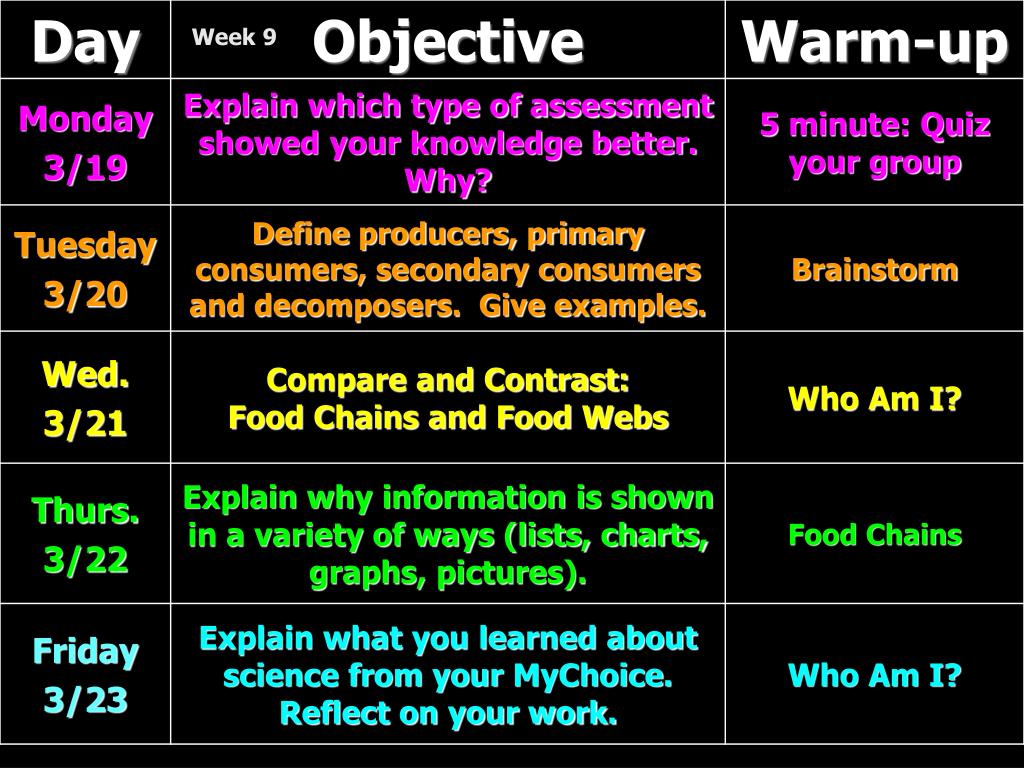
  1. Week 9 Warm-ups

  2. Agenda

  3. Vocabulary • Biotic: living parts of an ecosystem • Abiotic: non-living parts of an ecosystem Which is most important? Why?

  4. Interdependence All organisms depend on other organisms Levels: • Organism • Population (group of similar org. in same place, time) • Community (all populations in same place, time) • Ecosystem (community/biotic + abiotic factors) • Biome (REGIONAL ecosystem type)

  5. Levels: Organism Population Community Ecosystem Biome Defintions a living individual group of similar organisms – a single species - in same place, time all the biotic components (species) in the same place at the same time All the biotic and abiotic components in the same place at the same time A REGIONAL ecosystem, defined by the dominant plants and the climate InterdependenceAll organisms depend on other organisms

  6. Levels: Organism Population Community Ecosystem Biome Examples Zebra, wildebeast, dung beetles, lions, cheetahs, birds, elephants A specific savanna: the community above, plus the sun, water, etc. Troop of baboons, school of fish, herd of buffalo Grassland, Tropical Rainforest, Deciduous forest, Desert, etc. Maple tree, dog, cactus, or elephant InterdependenceMatch the levels to the examples

  7. Ecology Vocabulary Producer  Primary Consumer  Secondary Consumer, etc. (all  Decomposer) • Producer = plants produce their own food • Primary Consumer = herbivores • Secondary Consumer, etc. = carnivores • Third, fourth, fifth consumers can exist • Decomposer = bacteria, fungi, etc. that RETURN nutrients to environment to be reused.

  8. Ecosystem: All the natural biotic AND abiotic components of a habitat.

  9. Food Web: Connected Food Chains • Identify 3 food chains from this food web Grass  Caterpillar  Lizzard  Eagle Grass  Caterpillar  Bluebird  Eagle Grass  Snail  Bluebird  Eagle Grass  Bluebird  Eagle Grass  Rabbit  Eagle

  10. Food Webs • Food webs show connecting food chains • Always start with PRODUCERS • Plants PRODUCE their own food through photosynthesis… using sunlight energy! • They USE that food, but consumers also eat them which starts the food chain • Then CONSUMERS (primary, secondary, etc.) • Omnivores can be Primary Consumers in one food chain and Secondary Consumers in a second one within one food web. • DECOMPOSERS break down anything that dies and returns nutrients to the environment

  11. Who Am I? • You must ask a good science question about feeding level, character traits, location, etc. • Once enough questions have been asked that you think you know who I am, you may guess after your question • WRONG = you’re out • RIGHT = you WIN! Biomes (tropical rainforest, desert, grassland, deciduous forest, etc)Primary consumer, secondary consumer, omnivore, decomposer, camouflage Character Traits (# of legs, hair/feathers/scales, etc.)