Understanding Motion: Key Concepts of Speed, Velocity, and Forces
130 likes | 249 Vues
This chapter delves into the fundamental concepts of motion, including distance, displacement, speed, and velocity. Distance measures the space between two locations, while displacement captures the shortest path connecting them. Speed is defined as the distance traveled over time, and velocity incorporates direction into this measure. The chapter also explores forces, emphasizing the difference between balanced and unbalanced forces, as well as contact and non-contact forces. Key concepts like gravity, friction, and air resistance are introduced to illustrate their impact on motion.


Understanding Motion: Key Concepts of Speed, Velocity, and Forces
E N D
Presentation Transcript
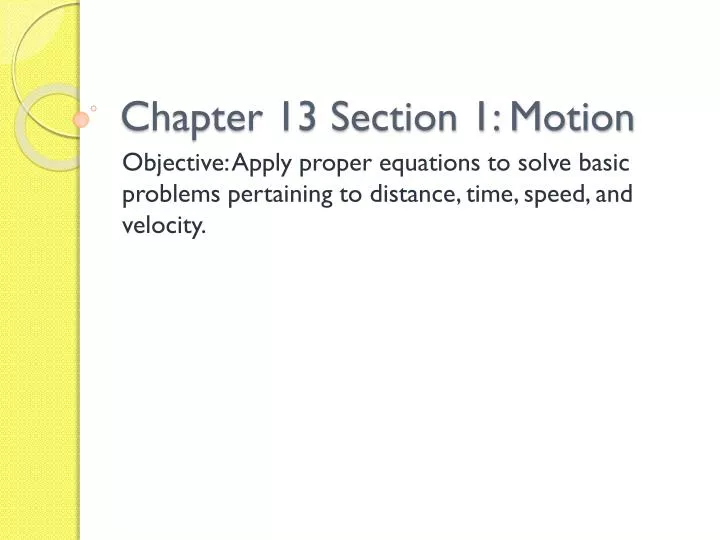
Chapter 13 Section 1: Motion Objective: Apply proper equations to solve basic problems pertaining to distance, time, speed, and velocity.
Distance and Displacement • Distance is a measure of the space between two locations • Displacement is the measure of the space between two locations measured along the shortest path connecting them. • Distance and direction
Relative Motion • Reference point: nonmoving object • Relative motion: the position of an object described relative to another object.
Speed • Speed: the distance you traveled divided by the time it took to travel the distance. • Constant Speed: for an object traveling at constant speed, the object’s speed at any interval of time does not change. • Average Speed = Distance/Time _ • V= d/t
Velocity • Velocity =Displacement /Time
Acceleration • Acceleration: the change in velocity divided by the amount of time required for the change to occur. • Speeding up, slowing down, or changing directions is considered accelerating
Force • Force: a push or a pull that one object exerts on another object • Force has both a size and a direction.
Forces Combine • net force: the combination of all the forces acting on an object • Forces can combine in the same direction or the opposite directions. • Draw AND write the captions for figure 7 on page 404.
Balanced and Unbalanced Forces • Balanced forces: if the forces acting on the object have a net force of zero • Unbalanced forces: if the forces acting on an object do not have a net force of zero
Contact and Noncontact Forces • Contact forces: a force that is exerted only when two objects are touching. • Noncontact Forces: forces that are exerted on objects without touching. • Ex: gravity, magnetic forces
Gravity and Friction • Gravity: a noncontact force that every object exerts on every other object due to their masses. • Weight: gravitational force Earth exerts on an object • Mass: amount of matter the object contains • Friction: is a contact force that resists the sliding motion of two objects touching
Air Resistance • Air resistance: a contact force that opposes the motion of objects moving in the air