Cell Structures
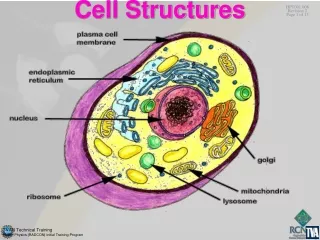
Explore the functions and components of eukaryotic cells, both plant and animal, including the nucleus, vacuole, lysosome, centriole, ribosome, ER, Golgi apparatus, chloroplast, mitochondria, cell wall, and membrane. Understand the differences between animal and plant cells and the organelles unique to each.

Cell Structures
E N D
Presentation Transcript
Found In: Eukaryotic Cells (both plant and animal) Function: Contains DNA and control’s the cell’s activities Picture: Nucleus
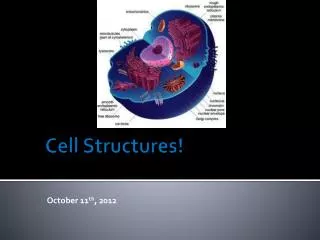
Label these on the Plant CellA- nucleus B- chromatin (DNA + protein that become chromosomes) C- Nucleolus (assembly of ribosomes begins here) D- nuclear envelope (two membranes that surround the nucleus and allow materials to come in/out) Label these on the Animal Cell A- nucleus B- nuclear envelope C-nucleolus D- chromatin Nucleus
Where Found: Eukaryotic Cells Function: sac-like structure used for storage (much larger in plant cells) Picture: Vacuole
Plant Cell Diagram G- vacuole Vacuole
Where Found: Animal Cells Function: Digestion and break down of molecules into small pieces that can be used by the cell or need to be gotten rid of. Picture: Lysosome
Label on Animal Cell N- lysosome Lysosome
Where Found: Animal Cells Function: Help organize cell division (2 centrioles = centrosome) Picture: Centriole
On Animal Cell L - centriole Centiole
Where Found: All Cells Function: Proteins are assembled here Picture: Ribosome
On Plant Diagram M – ribosome On Animal Diagram E - ribosome Ribosome
Where Found: Eukaryotic Cells Function: Contains enzymes that perform special tasks like synthesizing lipids and detoxification of drugs Picture: Smooth Endoplasmic Reticulum (Smooth ER)
On Plant Cell F- smooth ER On Animal Cell M- smooth ER Smooth ER
Where Found: Eukaryotic Cells Function: Has ribosomes on its surface and modifies proteins Picture: Rough Endoplasmic Reticulum (Rough ER)
On Plant Cell E – rough ER On Animal Cell F – rough ER Rough ER
Where Found: Eukaryotic Cells Function: Modifies, sorts, and packages proteins and other materials from the ER for storage in the cell Picture: Golgi Apparatus
On Plant Cell N – Golgi Apparatus On Animal Cell J – Golgi Apparatus Golgi Apparatus
Where Found: Plant Cells Function: They capture energy from the sun and perform photosynthesis. Picture: Chloroplast
On Plant Cell I - chloroplast Chloroplast
Where Found: Eukaryotic Cells Function: Convert chemical energy in food into compounds that can be used by cells. The “power house” of the cell. Picture: Mitochondria
On Plant Cell L – mitochondria On Animal Cell K - mitochondria Mitochondria
Where Found: Prokaryotic and Plant Cells Function: Provides support and protection Picture: Cell Wall
On Plant Cell J – cell wall Cell Wall
Where Found: All Cells Function: Regulates what enters/leaves and provides protection and support Picture: Cell Membrane
On Plant Cell K – cell membrane On Animal Cell G – cell membrane *cross out H on animal cell* Cell Membrane
Where Found: ALL Cells Function: area inside the cell membrane (NOT including the nucleus) Picture: Cytoplasm
On Animal Cell I - cytoplasm Cytoplasm
Where Found: Eukaryotic Cells Function: network of protein filaments that help the cell maintain its shape and move Picture: Cytoskeleton
Plant cell H- cytoskeleton Cytoskeleton
Ribosomes • Cell membrane • Cell wall • cytoplasm Organelles in Prokaryotic Cells
Nucleus • Vacuole • Ribosomes • Smooth ER • Rough ER • Golgi apparatus • Mitochondria • Cell membrane • Cytoplasm • cytoskeleton Organelles in Eukaryotic Cells
Found only in Animal • Lysosome * • Centriole * Found only in Plant • Chloroplast * • Cell wall * Animal vs. Plant Cells