Mastering Estimation Strategies in Mathematics: Practical Applications and Techniques
150 likes | 329 Vues
This guide covers essential estimation strategies for solving grade-level appropriate problems, verifying calculations, and ensuring precision in answers. Learn how to use rounding, front-end estimation, clustering, and compatible numbers effectively within various mathematical contexts. Explore problem-solving techniques for logic problems and model situations with flow charts. Understand the importance of estimation in determining the reasonableness of results and gain confidence in applying these methods. Ideal for students seeking to enhance their estimation skills and simplify complex calculations.


Mastering Estimation Strategies in Mathematics: Practical Applications and Techniques
E N D
Presentation Transcript
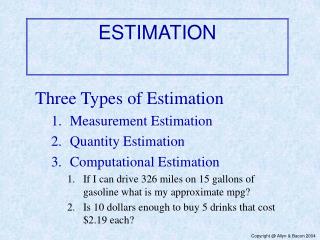
Estimation Strategies Strand 1: Concept 3 PO 1. Solve grade level appropriate problems using estimation. Strand 1: Concept 3 PO 2. Use estimation to verify the reasonableness of a calculation. Strand 1: Concept 3 PO 3. Express answers to the appropriate place or degree of precision Strand 1: Concept 3 PO 4. Verify the reasonableness of estimates made from calculator results within a contextual situation. Strand 5: Concept 2PO 1. Solve a logic problem given the necessary information. Strand 5: Concept 2 PO 2. Identify simple valid arguments using if…then statements Strand 5: Concept 2 PO 3. Model a contextual situation using a flow chart.
6.1 Why Estimate? • Depending on the situation, an estimate is often good enough and an exact answer is not needed. For example, a quick estimate can also help you check whether a total on a calculator or cash register is reasonable.
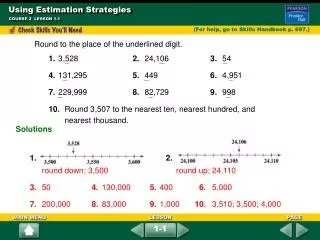
Round to $ Round to $ Strategy 1- ROUNDING: • USE WHEN #S SHARE A COMMON PLACE VALUE (ALL OPERATIONS) • Round each number to the same place value. $88.71 - $17.43 $___ - $___ = $___
Strategy 2 - FRONT-END ESTIMATION: • Use the first digit of each number and fill in zeros for the rest. • Subtract. • Round leftovers for each number and subtract • Add the numbers together 7,412 – 3,166 7000 – 3000 = 4000 400 – 200 = 200 4000 + 200 is about 4, 200 * When one # has many place values…addition/subtraction ONLY
Strategy 2 - FRONT-END ESTIMATION: • Add first digits • Round leftovers for each number and add • Add the numbers together $6.04 + $3.45 + $4.43 6 + 3 + 4 = 13.00 0.05 + 0.50 + 0.50 = 1.05 13.00 + 1.05 is about 14.05 * Works when trying to add number quickly
Strategy 3 - CLUSTERING: • Clustering is used to estimate several numbers that are close to the same value 7.9 + 8.2 + 8.3 + 7.8 + 7.7 All values are around 8 So, 85 = 40
Round to ______ Round to ______ Strategy 4 - COMPATIBLE NUMBERS: • Used when you are dividing. Round each first number and then round the second number so that it is easily divisible. 7,235 78 ______ ____ = _____
EXAMPLES:Estimate using an appropriate strategy. Tell which strategy you used. a. 576 – 395 b. 5,247 – 3,238 Front-end Rounding 5000 – 3000 = 2000 600 – 400 = 200 250 – 240 = 10 2000 + 10 = 2010
EXAMPLES:Estimate using an appropriate strategy. Tell which strategy you used. c. 3,500 62 d. 527 + 515 + 467 Clustering Compatible Numbers All values are around 500 3500 = 1500 3600 60 = 60
EXAMPLES:Estimate using an appropriate strategy. Tell which strategy you used. e.82.45 + 79.28 + 37.41 f. $6.99 + $6.94 + $7.15 Clustering Rounding All values are around $7 37 = 21 82 + 80 + 38 = 200
Closure: • Short Answer 1: Write two reasons for using estimation. • Short Answer 2: Tell what to do if you have several numbers to add and clustering does not work. • Short Answer 3: Show how front-end estimation is different from rounding.
NOTES on Estimating with Fractions • One way to estimate with fractions less than 1 is to round them to 0, ½, or 1. • Round 1/6 to 0. The numerator is much less than the denominator. • Round 3/8 to ½. The numerator is about half the denominator. • Round ¾ to 1 . The numerator is about the same as the denominator.
Example 1 Estimate 1/6 + 3/8 + ¾ • round each fraction • add the estimates 0 + ½ + 1 about 1½
Example 2 Estimate 7/8 – 1/3 • about ½ – ½ 1
Example 3 • Barry jogs 8 6/10 miles daily. Kerry jogs 5 ¾ miles daily. What is a reasonable estimate for how many more miles Barry jogs than Kerry? 1st: Write an equation… 3rd: Create a new equation and solve 8 6/10 – 5 ¾ 2nd: Round the fraction part 8 ½ - 6 6/10 rounds to ½ ¾ rounds to 1. about 2 ½ miles