Understanding Emerging Infectious Diseases: Challenges and Evolutionary Dynamics
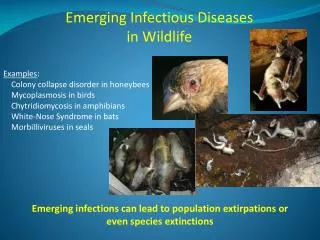
Emerging infectious diseases pose significant public health challenges due to their rapid evolution and adaptability. Microbes, including bacteria, reproduce swiftly, evolving faster than our research can keep pace. They can present as newly emerging diseases, re-emerging diseases, or known diseases manifesting in new territories. Factors driving these changes include shifts in human behavior, environmental changes, improper use of drugs, lapses in public health vigilance, and the globalization of food and travel. Understanding these dynamics is crucial for effective disease management and prevention.

Understanding Emerging Infectious Diseases: Challenges and Evolutionary Dynamics
E N D
Presentation Transcript
EMERGING INFECTIOUS DISEASES “Microbes and vectors swim in the evolutionary stream and they swim faster than we do. Bacteria reproduce every 30 minutes. For them, a millennium is compressed into a fortnight, they are fleet afoot, and the pace of our research must keep up with them, or they overtake us. Microbes were here on earth 2 billion years before humans arrived, learning every trick for survival, and it is likely that they will be here 2 billion years after we depart."
TYPES OF EMERGING DISEASES • Newly emerging diseases • Re-emerging diseases • New manifestations of known disease agents • Introduction of known agents to new territories
Internationalization of the Food Supply and Laboratory Animals