Understanding the Measurement of Stars: Brightness, Temperature, and More
240 likes | 385 Vues
This overview explores the fundamental aspects of measuring stars, including brightness, temperature, composition, distance, luminosity, size, and mass. Key relationships are discussed, such as how brightness and luminosity are linked, and the various methods used to determine distances, including radar and parallax techniques. The spectrum of a star provides crucial information regarding its temperature and composition, while also revealing its motion through the Doppler effect. The intrinsic properties of stars, like luminosity and radius, are analyzed to better comprehend their characteristics and behaviors in the universe.


Understanding the Measurement of Stars: Brightness, Temperature, and More
E N D
Presentation Transcript
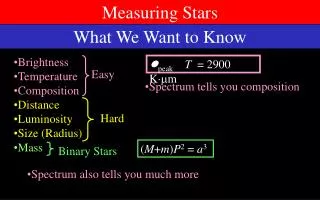
Measuring Stars Easy Hard Binary Stars What We Want to Know • Brightness • Temperature • Composition • Distance • Luminosity • Size (Radius) • Mass lpeakT = 2900 Km • Spectrum tells you composition (M+m)P2 = a3 • Spectrum also tells you much more
Luminosity and Brightness • The LuminosityL is how much power something is putting out • The BrightnessB is how brightsomething appears • They are related: Sphere: A = 4d2 d L = 4d2B Star A and star B are equally bright, but star A is farther away. Which one is actually more luminous? A) Star A B) Star B C) They are equally luminous D) There is insufficient information • The brightness is always easy to determine • If we can get one of the distance or the luminosity, we can get the other.
Finding the Distance Easy Hard • Brightness • Temperature • Composition • Distance • Luminosity • Size (Radius) • Mass • If we can get the distance, we can get the luminosity too • We will use a new unit for measuring distance, the light year • The distance light goes in a year ly = 9.46 1015 m = 63,240 AU • Real astronomers use parsecs • But we won’t
Methods for Finding Distance • Radar • Solar System Only • Excellent accuracy • Parallax • Nearby Stars (< 300 ly) • Moderate accuracy • Spectroscopic Parallax • Main Sequence Stars only • Poor accuracy
Radar Distance Earth Venus d 2d = ct, solve for d • We know what an AU is • Effectively no error
Methods for Finding Distance • Radar • Solar System Only • Excellent accuracy • Parallax • Nearby Stars (< 300 ly) • Moderate accuracy • Spectroscopic Parallax • Main Sequence Stars only • Poor accuracy
Parallax • The distance to an object can be judged if you view it from two angles • The difference in the angle you see it from is called parallax • The more distant, the smaller the parallax
Parallax p p • The farther apart you put your “two eyes”, the better you can judge distance • The smaller p is, the farther away the star is. d • p in arc-seconds (The distance 3.26 ly is also known as a parallax second) parsec nearest stars several ly away Centauri C = Proxima Centauri : 4.2 ly Sirius: 9 ly
Spectral Type • The following are all equivalent information: • The surface temperature of a star • The color of the star • The spectral type of the star • From hottest to coldest, OBAFGKM • Subdivided 0-9, with 0 the hottest • Sun is a G2 star • The spectral type is easy to determine Why I hate astronomers “Oh Be A Fine Girl, Kiss Me.” • Which star is hottest? • G2 B) G4 • C) F3 D) F7
Spectra and Motion – Doppler Effect Star A Spectrum Hydrogen Spectrum Star A is A) Made of a hydrogen variant B) Moving towards us C) Moving away from us D) Rotating
Announcements DateRead Today Sec. 11.1, 11.2 Wednesday Sec. 12.1, 12.2 Thursday Sec. 12.3 • Posted Now: • Test 2 questions • Test 2 solutions • Midterm grades • Lab Tonight • Out-4, Out-6, In-4 6/14
Spectra and Motion – Doppler Effect Star B Spectrum Hydrogen Spectrum • Binary stars are two stars that are orbiting each other • A spectroscopic binary are two stars that look like one but their binary nature can be deduced from their spectrum Star B is A) Made of two kinds of hydrogen B) Moving away from us AND moving towards us C) Actually two stars moving at different speeds
Spectra and Motion – Doppler Effect Star C Spectrum – Day 0 Star C Spectrum – Day 50 Star C Spectrum – Day 100 Star C Spectrum – Day 150 Star C Spectrum – Day 200 • Other object could be smaller in mass • This is the Doppler method whereby we discover planets around other stars Hydrogen Spectrum Star C is A) In orbit around an invisible companion B) Alternately expanding and contracting C) Alternately heating and cooling D) Rotating
Summary – What Spectra Tell Us • Temperature • From the peak of the spectrum • Composition • From wavelengths and strength of dark lines • Motion • From the Doppler shift • Multiplicity • From the number of sets of spectral lines • Orbit and masses • From the changing Doppler shift • Pressure and rotation • From width of lines
Luminosity, Temperature, and Radius • The spectrum of a star is pretty much a black body distribution • How bright each point on the surface is depends only on temperature • Multiply by the area to get the Luminosity F =T4 L = AF = 4R2T4 • Star X is the same temp. as the Sun, but it is 4 times more luminous. How large is it? • 2 times the Sun • 4 times the Sun • 16 times the Sun • 44 = 256 times the Sun
Intrinsic Properties of Stars • To describe stars, we want to talk about intrinsic properties • Luminosity • Composition • Temperature • Composition is almost always the same • Mass is difficult to measure • Radius can be deduced from Luminosity and Temperature • Radius • Mass Temperature andLuminosity
The Hertzsprung-Russell Diagram • A plot of temperature vs. luminosity • Hot on left, cold on right • Luminous at top, dim at bottom • Stars fall into categories: • The Main Sequence contains about 90% of the bright stars • The Giants are rare but very bright • The Supergiants are very rare but extremely bright • The White Dwarfs are not uncommon but very dim
Main Sequence Stars • Main Sequence stars have different sizes, masses, and luminosities • But spectral class determines everything else • This diagram shows correct relative sizesand approximate colors of stars • But not correct relative luminosities
Luminosity from Spectral Class • Suppose you have a G2 star. What is its luminosity? • 90% of all stars are main sequence G2: B5: K5: • For main sequence stars, the spectral type tells you the luminosity • Together with brightness, this tells you the distance • Spectroscopic parallax
Spectroscopic Parallax • Another distance method • Has nothing to do with parallax • Works only on main sequence stars • How it works: • Observe the star – determine it’s brightness B • Measure its spectral type from spectrum • Deduce its luminosity from the Hertzsprung-Russell Diagram • Find its distance from: L = 4d2B
Stellar Masses • Only some stars can have their masses measured • They need to be in binary systems • The masses of main sequence stars depends pretty much only on their spectral type T M T M T M O5 60 F0 1.6 K5 .74 B0 18 F5 1.3 M0 .51 B5 5.9 G0 1.05 M5 .21 A0 2.9 G5 .92 M8 .06 A5 2.0 K0 .85
The Main Sequence • The mass of a main sequence star affects everything • Temperature • More massive is hotter • Luminosity • More massive is much more luminous • Radius • More massive is bigger