Download
1 / 2
20 likes | 125 Vues
This review delves into the fundamentals of circuits, exploring the differences between series and parallel circuits and the role of key components like power sources, switches, and light bulbs. Learn how adding a light bulb affects a series circuit and how a light bulb can function as a switch. Discover the significance of closed and open circuits, electricity, batteries, and windmills as energy sources.

E N D
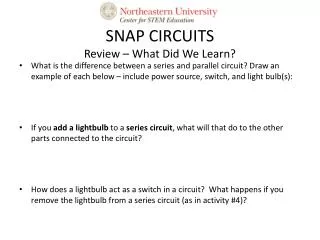
SNAP CIRCUITSReview – What Did We Learn? • What is the difference between a series and parallel circuit? Draw an example of each below – include power source, switch, and light bulb(s): • If you add a lightbulbto a series circuit, what will that do to the other parts connected to the circuit? • How does a lightbulb act as a switch in a circuit? What happens if you remove the lightbulb from a series circuit (as in activity #4)?
Review Words • Circuit: allows electricity to “go around” • Closed Circuit: one in which electricity is flowing • Open Circuit: no electricity is flowing • Electricity: a form of energy resulting from the movement of charged atoms (electrons) • Battery: a source of chemical energy which can be used to produce electrical energy • Windmill: uses wind energy (mechanical) to grind grain, pump water, or generate electrical energy