The Rise and Fall of Napoleon: Ambition, Reform, and Legacy
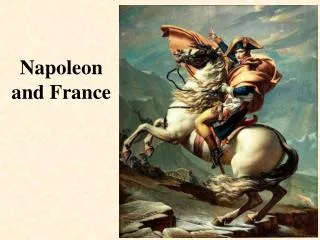
Napoleon Bonaparte, Emperor of France from 1804 to 1815, was a complex figure whose ambition drove him to great heights and ultimately to his downfall. He crowned himself emperor after a decade as First Consul, implementing significant reforms such as the Napoleonic Code, education advancements, and changes in taxation. Despite initial military successes in Europe, his campaign in Russia led to dire consequences, resulting in his exile. His legacy includes revolutionary ideals of equality before the law and merit-based advancement, as well as a grand tomb that reflects his significance in history.

The Rise and Fall of Napoleon: Ambition, Reform, and Legacy
E N D
Presentation Transcript
“Ambition is never content, even on the summit of greatness”
Napoleon IEmperor of France 1804-1815 “Republic” (1799-1804) Dictatorship/1st Consul “Consul for life” Named himself Emperor (1804) Crowned himself
REFORMS 1799 Tech/University/Secondary Schools Bank of France Napoleonic Code The Church
IMPERIALISM 1804Attempts to expand his boundaries Failure at sea Success on land Ego goes too far Sparks “Nationalism”
DOWNFALL Invasion into Russia 400,000 of 600,000 Dead Exiled to Elba Returned for 100 days Defeated at Waterloo House arrest on Saint Helena
Secured revolutionary ideals Equality before the law Religious toleration Advance by merit, not birth Uniform standards of government Reformed tax systems Promoted education Improved agriculture and industry LEGACY
“I closed the gulf of anarchy and brought order out of chaos. I rewarded merit regardless of birth or wealth, wherever I found it. I abolished feudalism and restored equality to all regardless of religion and before the law. I fought the decrepit monarchies of the Old Regime because the alternative was the destruction of all this. I purified the Revolution.”
The former emperor's body was returned to France from St Helena in 1840 and, after a state funeral, was laid to rest in St Jerome's Chapel while his tomb was completed in 1861. • There was no expense spared for the tomb and Napoleon Bonaparte's body lies within six separate coffins. They are made of iron, mahogany, two of lead, ebony, and the outer one is red porphyry. • The tomb sits on a green-granite pedestal surrounded by 12 pillars of victory.