Defining the Atom
The concept of the atom dates back to ancient Greece, where philosopher Democritus proposed that everything in the universe consists of indivisible particles he called "atoms." In modern science, atoms are defined as the smallest units of elements, made up of protons, neutrons, and electrons. The nucleus contains protons and neutrons, while electrons orbit around it. Subatomic particles form the framework of atomic structure, influencing chemical reactions and molecular formations. These fundamental components help us understand the universe's diversity and complexity, even though atoms themselves are too small to observe.

Defining the Atom
E N D
Presentation Transcript
Defining the Atom Hadi Syed
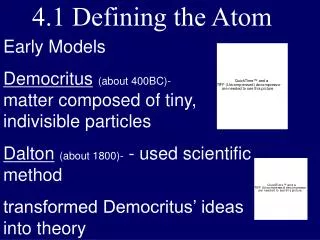
History • In Ancient Greece a man named Democritus figured out that every single thing in the universe must be made up of tiny particles that can’t be cut anymore • He called these particles “atoms”, which in Greek means “uncuttable”
What is an atom? • An atom is the smallest particle of an element
What’s inside an atom? • Protons and neutrons are made up of three quarks each • Electrons are a kind of lepton • Quarks and leptons are fundamental particles—the smallest particles in the Universe
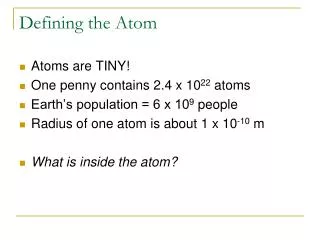
How big is atom? • The radius of a typical atom is one tenth of a billionth of a meter • A cube of sugar contains as many atoms as there are stars in the Universe
Subatomic particles • The particles smaller then atom are called subatomic particles
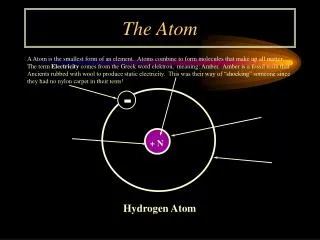
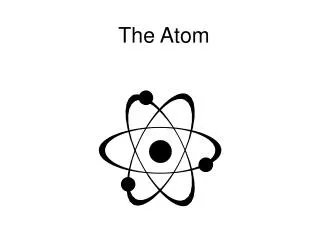
Center • At the center of the atom is a core called a nucleus, which is made up of these subatomic particles called protons and neutrons
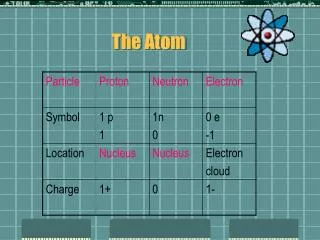
Nucleus • The nucleus of an atom contains protons and neutrons • The nucleus carries a positive electrical charge
Electrons • Moving around the nucleus at incredible speeds are tiny particles called electrons • Electrons move around outside the nucleus
Electrical Charge • Each electron has a negative electrical charge • Each proton has a positive electrical charge • The charge of a proton and an electron are equal in size, yet opposite in sign
Neutral Neutron • Each neutron is electrically neutral • Protons and neutrons are about the same size as each other and are much larger than electrons
Chemical Reaction • Electrons are easier to add or remove from an atom than a proton or neutron • Chemical reactions largely involve atoms or groups of atoms and the interactions between their electrons
Molecules • When atoms combine together they form molecules
Atomic Universe • By combining these atoms in different ways, we can make anything in the universe
Can you see an atom? • Atoms are so tiny that they can’t be seen, even with the most powerful microscope
Pictures • www.ehs.utoronto.ca - 1006 × 443 • www.universetoday.com - 300 × 250 • www.exo.net - 300 × 300 • www.exo.net - 591 × 565 • Clip art
Sources Elementary Atomic Structure by Gordon Kemble Wood gate · Clarendon Press http://profmokeur.ca/chemistry/history_of_the_atom.htm All About Atoms All Atoms Atomic Alchemy: Nuclear Processes