X-ray Interpretation Skills
Enhance your skills in X-ray interpretation with Dr. Hisham Alsanawi, Assistant Professor of Medical Decision Making. This comprehensive guide emphasizes a systematic approach to evaluating orthopedic X-rays through the ABCs framework: Assessing Adequacy, Alignment, Bones, Cartilage, and Soft Tissues. Learn to recognize key signs of fractures, joint injuries, and soft tissue changes. With practical examples, this resource will improve your diagnostic accuracy and communication with orthopedic specialists, ensuring optimal patient outcomes.

X-ray Interpretation Skills
E N D
Presentation Transcript
X-ray Interpretation Skills Dr. HishamAlsanawi Assistant Professor
Medical Decision Making is a Triad • History – from patients/records • Physical Examination • Confirming Studies – Imaging, Labs, etc.
Imaging • X-ray • Ultrasound • CT Scan • MRI • Nuclear Medicine
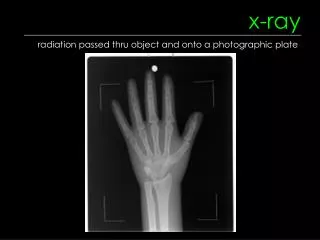
X-RAY • Radiation Source • Patient Exposed • Capture Image • Interpret Image
X-RAY • Ionizing Radiation • Radiation damages cells
X-RAY • Patient Blocks Transmission of Radiation • Soft tissues Less • Bones More
X-RAY • Capture Image • Films • Digital
X-RAY • Interpret Image • Radiologist • Orthopaedist
X-RAY • Best for: • Hard tissue • Bones • Often combined with other imaging
OBJECTIVES • Review a systematic approach to interpreting orthopedic x-rays • Review the language of fracture description
ABCs APPROACH • Pre ABC: identify pt, read provided info • A • Adequacy • Alignment • B • Bones • C • Cartilage • S • Soft Tissues • Apply ABCs approach to every orthopedic film you evaluate
ADEQUACY • All x-rays should have an adequate number of views. • Minimum of 2 views—AP and lateral • 3 views preferred • Joint above and joint below • All x-rays should have adequate penetration
ALIGNMENT • Alignment: Anatomic relationship between bones on x-ray • Bone alignment vs other side • Bone alignment relative to proximal and distal bones • Normal x-rays should have normal alignment • Fractures and dislocations may affect the alignment on the x-ray
BONES • Identify bone • Examine the whole bone for • Discontinuity fractures • Change in bone shadow consistency change in density • Describe bone abnormality • Location • Shape
CARTILAGE • Cartilage • joint spaces on x-rays • you cannot actually see cartilage on x-rays • Widening of joint spaces signifies ligamentous injury and/or fractures • Narrowing of joint spaces arthritis
SOFT TISSUES • Soft tissues implies to look for soft tissue swelling and joint effusions • These can be signs of • Trauma • occult fractures • Infection • Tumors
REVIEW: ABCs • A • Assess adequacy of x-ray which includes proper number of views and penetration • Assess alignment of x-rays • B • Examine bones throughout their entire length for fracture lines and/or distortions • C • Examine cartilages (joint spaces) for widening • S • Assess soft tissues for swelling/effusions
EXAMPLE # 1… • This x-ray demonstrates a lateral elbow x-ray. • There is swelling anteriorly which is displaced known as a pathologic anterior fat pad sign • There is swelling posteriorly known as a posterior fat pad sign • Both of these are signs of an occult fracture although none are visualized on this x-ray • Remember, soft tissue swelling can be a sign of occult fracture!
EXAMPLE # 2… • If you follow ABCs, you will notice there is are problems with alignment on this x-ray (A) • (B)…You will notice there are fracture lines through the 2nd, 3rd, and 4th metacarpals • These are 2nd, 3rd, and 4th, midshaft metacarpal fractures. • A teaching point: Notice the ring on this film. Always remove rings of patients with fractured extremities because swelling may preclude removal later.
LANGUAGE OF FRACTURES • Important for use to describe x-rays in medical terminology. • Improves communication with orthopedic consultants
LANGUAGE OF FRACTURES • Things you must describe (clinical and x-ray): • Open vs Closed fracture • Anatomic location of fracture • Fracture line • Relationship of fracture fragments • Neurovascular status
OPEN VS CLOSED • Must describe to a consultant if fracture is open or closed • Closed fracture • Simple fracture • No open wounds of skin near fracture • Open fracture • Compound fracture • Cutaneous (open wounds) of skin near fracture site. Bone may protrude from skin • Open fractures are open complete displaced and/or comminuted
OPEN FRACTURES • Orthopedic emergency • Requires emergency orthopedic consultation • Bleeding must be controlled • Management • IV antibiotics • Tetanus prophylaxis • Pain control • Surgery for washout and reduction
ANATOMIC LOCATION • Describe the precise anatomic location of the fracture • Include if it is left or right sided bone • Include name of bone • Include location: • Proximal…Mid…Distal • To aid in this, divide bone into 1/3rds
EXAMPLE… • This is a closed L distal femur fracture. • The main thing I want you to take from this example is the description of location
ANATOMIC LOCATION • Besides location, it is helpful to describe if the location of the fracture involves the joint space—intra-articular
FRACTURE LINES • Next, it is imperative to describe the type of fracture line • There are several types of fracture lines
FRACTURE LINES • A is a transverse fracture • B is an oblique fracture • C is a spiral fracture • D is a comminuted fracture • There is also an impacted fracture where fracture ends are compressed together
ANS: TRANSVERSE FRACTURE • Transverse fractures occur perpendicular to the long axis of the bone. • To fully describe the fracture, this is a closed midshaft transverse humerus fracture.
ANS: SPIRAL FRACTURE • Spiral fractures occur in a spiral fashion along the long axis of the bone • They are usually caused by a rotational force • To fully describe the fracture, this is a closed distal spiral fracture of the fibula