Dev Challenges: Bangladesh vs US Development Disparities
Explore the development challenges faced by Bangladesh compared to the US, including issues like overpopulation, healthcare, and income disparities. Learn about key factors affecting development and economic growth.

Dev Challenges: Bangladesh vs US Development Disparities
E N D
Presentation Transcript
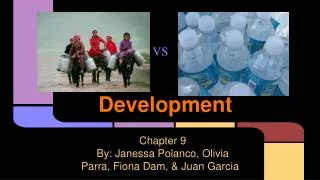
VS Development Chapter 9 By: JanessaPolanco, Olivia Parra, Fiona Dam, & Juan Garcia
Case Study: Bangladesh’s Development Challenges • Many couples give birth to an overabundance of children in order to support family. • There is no health care to treat things like tuberculosis, or to almost guarantee a live birth. • Compared, to the U.S. where the average income is $4000 a month, the average working household gets around $16, barely enough to supply the minimum amount of food.
MDC LDC • 20 students/ 1 teacher • 98% literacy rate • life span: 70 • Infant Mortality Rate: <.5% • NIR: 0.2% • CBR: 12 to 1000 • 30 students/ 1 teacher • 60% literacy rate • life span: 60 if survived first 5 years • Infant Mortality Rate: 6% • NIR: 1.5% • CBR: 23 to 1000
VS Sub-Saharan Africa United States
How HDI is Calculated • You classify a country by selecting oneeconomic factor, two social factors, and one demographic factor. Then from there a team of analysts best reveal a country’s level of development: • Economic factor:GDP (gross domestic product) per capita • Social factors: literacy rate and amount of education • Demographic factor: life expectancy
Economic Sectors three-sector hypothesis:common system of division of major economic activities into: primary, secondary, and tertiary sectors ↛ primary:acquiring of natural resources and raw materials ■ wood, steel, coal ■ industries such as forestry, fishing, and farming ↛ secondary:production/processing of merchandise ■ homes, devices, vehicles, pottery, building structures ↛ tertiary: offered services ■ real estate agents, management, financial assistance
Theories and Models of Economic Development ↛ Harrod-Domar Growth Model - economy’s growth rate: ■ amount of saving/efficiency of investment ■ net investment leads to more capital accumulation, which generates higher output and income. ↛ Lewis Structural Change Model - dual economy: ■ models the change of capitalist and subsistence sectors ■ higher incomes generate savings/more savings mean more fund available for investment.
Gender-Related Development Index According to the UN gender inequality exists in every country in favor of males, some more than others.
How GDI is calculated • Economic indicator of gender differences: Per capita female income as a percentage of per capita male income. • Social indicators of gender differences:# of females enrolled in school compared to males and % of of literate females: % of literate males • Demographic indicator of gender differences:life expectancy of females to males
Self-Sufficiency Self-Sufficiency: “Balanced equally. Equal economy, reduce poverty, isolate businesses to help, barriers limit imports, restrict local business” -quizlet Purpose? “Under self-sufficiency, incomes in the countryside keep pace with those in the city, and reducing poverty takes precedence over encouraging a few people to become wealthy consumers.”
How Self-Sufficiency is Promoted • Taxes: also known as tariffs are placed on imported items so they are not easily affordable • Quotas:used to limit the quantity of imported goods • Licenses:required to restrict # of legal importers
Millennium Development Goals • End poverty and hunger • Achieve universal primary education • Promote gender equality • Reduce child mortality • Improve maternal health • Combat HIV/AIDS, malaria, and other diseases • Ensure environmental stability • Develop a global partnership for development
Vocabulary • fair trade: products are made and traded according to standards that protect workers and small businesses in LDCs • productivity:the value of a particular product compared to the amount of labor needed to make it • value added:the gross value of the product minus the costs of raw materials and energy