Understanding the Passive Voice: A Comprehensive Guide
The passive voice is a crucial aspect of English grammar. It shifts the focus from the doer of the action to the action itself or the recipient. This guide explains what the passive voice is, when to use it, and how to construct passive sentences across different tenses. With practical examples and exercises, you will learn to recognize and use the passive voice effectively in writing, especially in journalism and scientific contexts. Enhance your grammar skills and improve your writing clarity through this detailed exploration.

Understanding the Passive Voice: A Comprehensive Guide
E N D
Presentation Transcript
The Passive Voice What, why, when, where and how?
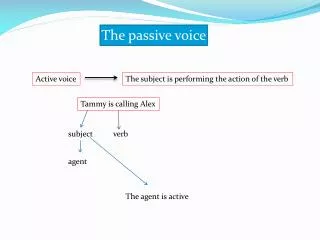
In most sentences, we can recognize the following “formula”: Thing/Person doing the action(My friend) + verb(is feeding) + thing/person receiving action( his dog.)
Let's examine the following sentences: • Ellen saw David at the mall yesterday. • David was seen at the mall yesterday. • In both sentences, the verb "to see" is being used. • In the first sentence, Ellen did the "action". • In the second sentence, we don't know from reading the sentence who saw David but we know that someone saw him.
When it is obvious that the subject of the sentence is not the one who did the action, and the action is “done” to/on him, we say that the sentence is inthe passive voice. כאשר ברור שהנושא של המשפט הוא לא זה שעושה את הפעולה כלומר, הפעולה נעשתה לו או עליו, אנו אומרים שהמשפט הוא בצורת ה"סביל".
When do we use it? • When we are interested in the act that was done but we don't know who did. Example: My neighbour's car was stolen. The action was done by an unknown thief. • When the action is more important to us than the identity of the one who did. Example: The gift will be delivered before the holiday. We are interested in its arrival on time and not in who will deliver it.
The passive is used more in journalism (newspapers, magazines) than in fiction (novels, stories), but most journalists and fiction writers use far more active than passive sentences. However, using the passive voice is very common in all types of scientific and technical writing.
How do we use it? Subject + to be in the suitable tense + Past Participle The past participle = verb+ed/3rd column of irregular verbs Examples: The table is cleaned after every meal. The table is being cleaned now. The table was cleaned after we ate. The table was being cleaned when we entered the restaurant. The table will be cleaned in a few moments.
ACTIVE / PASSIVE - EXAMPLES: • Simple PresentOnce a week, Tom cleans the car.ACTIVEThe car is cleaned once a week. (by Tom?)PASSIVE • Simple PastTom repaired the car. ACTIVEThe car was repaired by Tom. PASSIVE
MORE EXAMPLES: • Present ContinuousRight now, Tom is writing the letter.ACTIVERight now, the letter is being written by Tom.PASSIVE • Past ContinuousThe salesman was helping the customer when the thief came into the store. ACTIVEThe customer was being helped by the salesman when the thief came into the store. PASSIVE
MORE EXAMPLES: • Simple FutureJohn will certainly finish the work by 5:00 PM. ACTIVE The work will certainly be finished by 5:00 PM. PASSIVE Sally is going to make a beautiful dinner tonight. ACTIVE A beautiful dinner is going to be made by Sally tonight. PASSIVE
Practicing on the web: In the following links you will be able to practice the subject you’ve just learned: • Exercise on Passive with Simple Present • Exercise on Passive with Simple Present • Exercise on Simple Present • Exercise on Passive with Simple Past • Exercise on Passive with Simple Past • Exercise on Simple Past • Exercise on Passive with Future I • Exercise on Passive with Future II • Exercise on Passive with Present Progressive • Exercise on Passive with Past Progressive • Show Passive Voice in „History of Snowboarding“ • Show Passive Voice in „The Canterville Ghost“ • English irregular verbs