Advancements in Image-Based Modeling and Rendering Techniques for Photorealistic Scenes
This work explores the evolution of image-based modeling and rendering techniques that enable the creation of photorealistic models from real-world scenes. It discusses the progression from 1st generation methods, which varied viewpoint but not lighting, to 2nd and 3rd generation approaches that incorporate variations in lighting and scene configurations. Key contributions include recovering geometry and reflectance properties, as well as rendering under novel illumination. The techniques utilize digital cameras for data acquisition and address challenges in automatic correspondence finding between views.

Advancements in Image-Based Modeling and Rendering Techniques for Photorealistic Scenes
E N D
Presentation Transcript
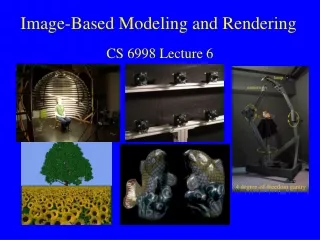
Image Based Modeling and Rendering (PI: Malik) • Capture photorealistic models of real world scenes that can support interaction • Vary viewpoint • Vary lighting • Vary scene configuration • This objective was achieved by combining and inventing new techniques in computer vision and graphics.
Image-based Modeling and Rendering • 1st Generation---- vary viewpoint but not lighting • Acquire photographs • Recover geometry (explicit or implicit) • Texture map
Image-based Modeling and Rendering • Photographs are not Reflectance Maps ! • 2nd Generation---- vary viewpoint and lighting for non-diffuse scenes • Recover geometry • Recover reflectance properties • Render using light transport simulation Illumination Radiance Reflectance
Image-based Modeling • 2nd Generation---- vary viewpoint and lighting • Recover geometry & reflectance properties • Render using light transport simulation or local shading Original Lighting & Viewpoint Novel Lighting & Viewpoint
Inverse Global Illumination (Yu et al, SIGGRAPH 99) Reflectance Properties Radiance Maps Light Sources Geometry
Key contributions in Inverse Global Illumination • A digital camera can undertake all the data acquisition tasks involved. • Both specular and high resolution diffuse reflectance properties can be recovered from photographs. • Reflectance recovery can re-render non-diffuse real scenes under novel illumination as well as from novel viewpoints.
Image-based Modeling and Rendering • 3rd Generation--Vary spatial configurations in addition to viewpoint and lighting Novel Viewpoint Novel Viewpoint & Configuration
Input Multiple range scans of a scene Multiple photographs of the same scene Output Geometric meshes of each object in the scene Registered texture maps for objects Framework
Transitions • Façade has inspired several image-based modeling packages including Canoma from Metacreations. • Technique for registering range and radiance images being used by Cyra, a leading time of flight laser scanner company.
Continuing Challenges • Finding correspondences between widely separated camera views automatically • Models of reflectance and texture for natural materials and objects