Solving SSA Case in Triangles: Understanding One and Two Solutions
This guide explains how to solve SSA (Side-Side-Angle) cases in triangles using the law of sines. It covers examples of triangles that have one solution, two solutions, or no solution based on given angles and side lengths. By applying sketches, calculations, and the law of sines, you can determine the measures of unknown angles and side lengths for various triangle scenarios. Learn the importance of angles and their relationships, and get step-by-step instructions to navigate through complex triangle problems.

Solving SSA Case in Triangles: Understanding One and Two Solutions
E N D
Presentation Transcript
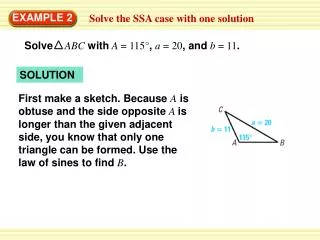
Solve ABCwithA = 115°,a = 20, andb = 11. EXAMPLE 2 Solve the SSA case with one solution SOLUTION First make a sketch. Because Ais obtuse and the side opposite A is longer than the given adjacent side, you know that only one triangle can be formed. Use the law of sines to find B.
= 11 sin 115° 0.4985 sin B = 20 29.9° B = You then know that C 180° – 115° – 29.9° = 35.1°. Use the law of sines again to find the remaining side length cof the triangle. sinB sin 115° 20 11 EXAMPLE 2 Solve the SSA case with one solution Law of sines Multiply each side by 11. Use inverse sine function.
= c = c c sin 35.1° 12.7 ANSWER 20 InABC,B 29.9°,C 35.1°,andc 12.7. sin 115° 20 sin 35.1° sin 115° EXAMPLE 2 Solve the SSA case with one solution Law of sines Multiply each side by sin 35.1°. Use a calculator.
Solve ABCwithA = 51°,a = 3.5, and b = 5. Begin by drawing a horizontal line. On one end form a 51° angle (A) and draw a segment 5 units long (AC, or b). At vertex C, draw a segment 3.5 units long (a). You can see that aneeds to be at least 5sin51°3.9 units long to reach the horizontal side and form a triangle. So, it is not possible to draw the indicated triangle. EXAMPLE 3 Examine the SSA case with no solution SOLUTION
Solve ABCwithA = 40°,a = 13, and b = 16. First make a sketch. Because bsinA = 16sin 40°10.3, and 10.3 < 13 < 16(h < a < b), two triangles can be formed. Triangle 1 Triangle 2 EXAMPLE 4 Solve the SSA case with two solutions SOLUTION
sinB = 16 16 sin 40° sin 40° 0.7911 = sinB 13 13 There are two angles Bbetween 0° and 180° for which sinB 0.7911. One is acute and the other is obtuse. Use your calculator to find the acute angle: sin–1 0.7911 52.3°. The obtuse angle has 52.3° as a reference angle, so its measure is 180° – 52.3° = 127.7°. Therefore, B 52.3° or B 127.7°. EXAMPLE 4 Solve the SSA case with two solutions Use the law of sines to find the possible measures of B. Law of sines Use a calculator.
Triangle 1 Triangle 2 C 180° – 40° – 52.3° = 87.7° C 180° – 40° – 127.7° = 12.3° c c = = sin 87.7° sin 12.3° 13 sin 12.3° 13 sin 87.7° c 20.2 c 4.3 = = sin 40° sin 40° 13 13 sin 40° sin 40° In Triangle 1,B 52.3°, C 87.7°, In Triangle 2,B 127.7°, C 12.3°, ANSWER ANSWER andc 20.2. andc 4.3. EXAMPLE 4 Solve the SSA case with two solutions Now find the remaining angle Cand side length c for each triangle.
Solve ABC. = 12 sin 122° 0.5653 = You then know that C 180° – 122° – 34.4° = 23.6°. Use the law of sines again to find the remaining side length cof the triangle. 18 sin B 34.4° = sinB sin 122° B 18 12 for Examples 2, 3, and 4 GUIDED PRACTICE 3. A = 122°,a = 18,b = 12 SOLUTION Law of sines Multiply each side by 12. Use inverse sine function.
= c = c c sin 23.6° 8.5 ANSWER 18 InABC,B 34.4°,C 23.6°,andc 8.5. sin 122° 18 sin 23.6° sin 122° for Examples 2, 3, and 4 GUIDED PRACTICE Law of sines Multiply each side by sin 23.6°. Use a calculator.
Solve ABC. for Examples 2, 3, and 4 GUIDED PRACTICE 4. A = 36°,a = 9,b = 12 SOLUTION Because bsinA = 12sin 36°≈ 7.1, and 7.1 < 9 < 13(h < a < b), two triangles can be formed.
sinB = 12 12 sin 36° sin 36° 0.7837 = sinB 9 9 There are two angles Bbetween 0° and 180° for which sinB 0.7831. One is acute and the other is obtuse. Use your calculator to find the acute angle: sin–1 0.7831 51.6°. The obtuse angle has 51.6° as a reference angle, so its measure is 180° – 51.6° = 128.4°. Therefore, B 51.6° or B 128.4°. EXAMPLE 4 Solve the SSA case with two solutions Use the law of sines to find the possible measures of B. Law of sines Use a calculator.
Triangle 1 Triangle 2 C 180° – 36° – 51.6° = 92.4° C 180° – 36° – 128.4° = 15.6° c c = = sin 92.4° sin 15.6° 9 sin 15.6° 9 sin 92.4° c 15.3 c 4 = = sin 36° sin 36° 9 9 sin 36° sin 36° In Triangle 1,B 51.6°, C 82.4°, In Triangle 2,B 128.4°, C 15.6°, ANSWER ANSWER andc 15.3. andc 4. EXAMPLE 4 Solve the SSA case with two solutions Now find the remaining angle Cand side length c for each triangle.
Solve ABC. ANSWER Since a is less than 3.06, based on the law of sines, these values do not create a triangle. for Examples 2, 3, and 4 GUIDED PRACTICE 5. A = 50°,a = 2.8,b = 4 2.8 ? b · sin A 2.8 ? 4 · sin 50° 2.8 < 3.06
= 6 sin 105° 0.4458 = You then know that C 180° – 105° – 26.5° = 48.5°. Use the law of sines again to find the remaining side length cof the triangle. 13 sin A 26.5° = sinA sin 105° A 13 6 for Examples 2, 3, and 4 GUIDED PRACTICE Solve ABC. 6. A = 105°,b = 13,a = 6 SOLUTION Law of sines Multiply each side by 6. Use inverse sine function.
= c = c c sin 48.5° 10.1 13 ANSWER InABC,A 26.5°,C 48.5°,andc 10.1. sin 105° 13 sin 48.5° sin 105° for Examples 2, 3, and 4 GUIDED PRACTICE Law of sines Multiply each side by sin 48.5°. Use a calculator.