Une image / un lien ci-dessous est fourni (tel quel) pour télécharger la présentation
Politique de téléchargement : le contenu du site vous est fourni TEL QUEL pour votre information et votre usage personnel ; il ne peut être vendu, concédé sous licence ni partagé sur d’autres sites sans l’accord de son auteur.Le contenu vous est fourni TEL QUEL, pour votre information et votre usage personnel uniquement.Téléchargez la présentation en cliquant sur ce lien.Lors du téléchargement, si vous ne parvenez pas à télécharger une présentation, l’éditeur a peut-être supprimé le fichier de son serveur.Pendant le téléchargement, si vous ne parvenez pas à obtenir une présentation, le fichier a peut-être été supprimé par l’éditeur.
F I N
Plus de contenu associé
Transcription de la présentation
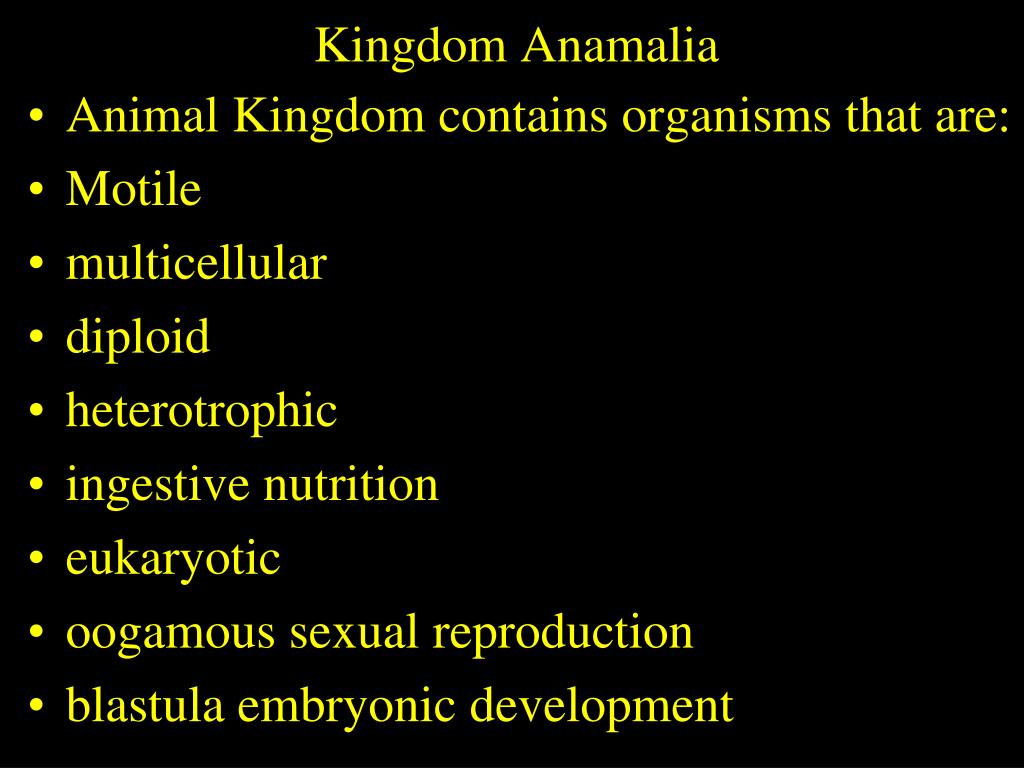
Kingdom Anamalia • Animal Kingdom contains organisms that are: • Motile • multicellular • diploid • heterotrophic • ingestive nutrition • eukaryotic • oogamous sexual reproduction • blastula embryonic development
Kingdom Anamalia • The Animal Kingdom contains the most species (more than 1 million known and an estimated 1 million undiscovered) • We will study 10 phyla divided into subphyla, classes and orders • 5 Lower Phyla of Invertebrates (sponges, jellyfish some worms) • 4 Higher Phyla of Invertebrates (snails, insects, starfish) (+ 2 sub-phyla) • 1 Chordata Sub-Phyla (fish, birds, reptiles, amphibians, mammals & me & you)
Kingdom Anamalia • Multicellular Animals = Metazoa • The metazoan cell is a specialized part of the whole organism and is incapable of independent existence • Protozoan cells can live independently
Kingdom Anamalia - Criteria for phylum placement • 1) Number of cells/level of organization, cells > tissues > organs > systems • 2) Number of Embryonic “Germ Layers” • diploblastic - 2 layers of tissue - ectoderm & endoderm, separated by a mesoglea layer “middle glue” • triploblastic - ectoderm - skin & nervous tissue - mesoderm - support & movement - endoderm - digestive organs, spleen, pancreas
Kingdom Anamalia • Embryonic layers develop into body layers • Most animals become a “tube within a tube” • Inner tube, endoderm, is lining of the digestive tract and reproductive system • Outer tube, ectoderm, is protective and sense organs • In between tubes, mesoderm, are reproductive, muscular, circulatory and excretion systems.
Kingdom Anamalia • Animals with three body layers can be divided into three categories • Acoelomates have no space between their layers • Coelomates contain a fluid-filled space in the mesoderm (coelom). This allows their body organs to move independently. • Pseudocoelomates - fluid-filled pseudocoel between layers
Kingdom Anamalia - Criteria for phylum placement • 3) Determination of basic structural relationships • Homologies - homologous structures - a structure with similar structure and derived from the same embryonic tissue • (wing of a bat, wing of a bird, fin of a fish, arm of a human) • Analogies - Analogous structures - structure with similar function but different embryonic tissues • (leg of a centipede/ dog -or- wings of bee / bird)
Kingdom Anamalia - Criteria for phylum placement • 4) Body symmetry in the young and in the adult • Asymmetry - no equal sides • Radial symmetry - central point, several places to divide in half equally - ex. Starfish • Bilateral symmetry - 1 plane of symmetry ex. Human • Related terms: anterior, posterior, ventral, dorsal, frontal plane, transverse plane, sagittal plane, proximal & distal
Kingdom Anamalia - more symmetry terms • Oral - toward the mouth • Aboral - away from the mouth • Caudal - toward the tail • Lateral - on the side • Medial - toward the midline
Kingdom Anamalia - Phylum Porifera • “The Sponges” “Pore-bearing” 5,000 species • Sponges are simple, sessile, solitary or colonial filter feeders. They must live in water. • They are not true metazoans, because they have no tissues or organs - just specialized cells which are capable of some independent life. • (H. V. Wilson and his fine silk, 3 weeks recovery) • Sponges have radial or asymmetrical bodies, simple sponges have a vase-shaped body, sometimes with folds inside.
Kingdom Anamalia - Phylum Porifera • Sponges are diploblasts with a specialized mesoglea that becomes a gelatinous matrix between endoderm & ectoderm. This mesoglea contains: • pinacocytes - outer layer for protection • porocytes - ring-shaped cells that form pores called ostia • choanocytes - collar cells, facing inward with flagella that create the feeding current and microvilli that trap food • amoebocytes - transport/digest food
Kingdom Anamalia - Phylum Porifera • Archeocytes - totipotent cells that can morph into any of the above type cells or produce egg & sperm cells • A skeleton also exists in this layer, made of resilient fibrous protein called spongin and sharp little calcium carbonate spikes called spicules. The skeleton is used as a common bathing sponge. • Some sponges are symbionts with algae or cyanobacteria, giving them vibrant colors
Kingdom Anamalia - Phylum Porifera • Feeding is accomplished by choanocytes drawing water in and filtering out microscopic plankton and dead tissue. • Amoebocytes phagocytize and digest food, moving it about the sponge • Water passes out an opening at the top of the sponge, called the osculum. Wastes are removed along with extra water. • Carbon dioxide and oxygen are exchanged through diffusion - no organs or systems
Kingdom Anamalia - Phylum Porifera • Reproduction occurs in several forms • Asexual through budding or fragmentation and regeneration • Sexual by flagellated sperm swims out of male sponge and is trapped in feeding current of a female with an egg. The zygote becomes a ciliated free swimming larvae before settling down. Monoecious and hermaphroditic. • Some form gemmules - little balls of amoeboid cells surrounded by spicules that break off to form a new adult. Some overwinter as gemmules.
Kingdom Anamalia - Phylum Cnidaria Cnid = nettle or irritate Radial Symmetry, Diploblastic Entirely aquatic, mostly marine Tissue level of organization, exception-tentacles are organs (skin, muscle & nerve) Incomplete digestive system - single opening for mouth and anus (surrounded by tentacles) Digestive enzymes are secreted into the gut
Kingdom Anamalia - Phylum Cnidaria Contain cnidocytes (stinging cells) on tentacles Cnidocil is a trigger Nematocyst is the stinger - it is barber with neurotransmitters and can stick to or wrap around prey
Kingdom Anamalia - Phylum Cnidaria Simple nervous net (statocysts) that is used for balance and orientation (no brain = no “thinking”) No excretory / no respiratory, simple diffusion accomplishes all gas exchange & waste needs
Kingdom Anamalia - Class Hydrozoa May be solitary or live in colonies Typical life cycle includes polyp & medusa example:Hydra freshwater, solitary polyp - never colonial or medusa reproduces asexually by budding or sexual under poor conditions producing sperm or eggs in gonad, but never both
Kingdom Anamalia - Class Hydrozoa Example: Portuguese man-of-war Looks like a jellyfish, but is actually a floating Colony of four different types of polyps: -the float polyp - gas filled for floating -the reproductive polyp - asexual -the tentacle polyp - stinging cells -the digestive polyp - shares with the colony
Connexion au compte
Connectez-vous pour publier votre contenu sur SlideServe.