Scientific Method
The scientific method is a systematic approach to discovering new information through structured steps. Begin with observation to identify a problem, followed by thorough research to gather relevant data. Formulate a testable hypothesis, design experiments that isolate variables, and perform those experiments carefully. Collect and analyze data to draw conclusions, and remember to retest for validity. By following these steps, you enhance your inquiry skills and support scientific discovery, making your findings reliable and worthwhile.

Scientific Method
E N D
Presentation Transcript
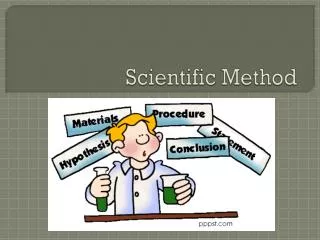
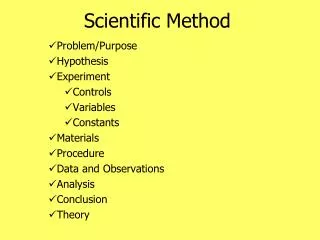
Steps in the Scientific Method • Observation • Research the problem • Form a Hypothesis • Design the experiment • Perform the experiment • Data Collection • Conclusion • Retest
Observations / Choose a Problem • Gathered through your senses • A scientist notices something in their natural world that they wonder about
Observations An exampleof an observation might be noticing that many salamanders near a pond have curved, not straight, tails- which leads to the problem of why the salamanders have curved, not straight tails
Research the Problem • Using many sources, such as internet, books, periodicals, etc. find out as much information about the problem as possible
Hypothesis • A suggested solution to the problem. • Must be testable • Sometimes written as If…Then… statements • Predicts an outcome
Hypothesis • An example of a hypothesis might be that the salamanders have curved tails due to a pollutant in the moist soil where they live.
Experiment • A procedure to test the hypothesis.
Experiment Variable – factor in the experiment that is being tested
Experiment A good or “valid” experiment will only have ONE variable!
Scientific Experiments Follow Rules • An experimenter changes one factor andobserves or measureswhat happens.
The Control Variable • The experimenter makes a special effort to keep other factors constant so that they will not effect the outcome. • Those factors are called control variables.
What is the Purpose of a Control? • Controls are NOT being tested • Controls are used for COMPARISON
Other Variables • The factor that is changed is known as the independent variable. • The factor that is measured or observed is called the dependent variable.
Example of Controls & Variables • For example, suppose you want to figure out the fastest route to walk home from school. • You will try several different routes and time how long it takes you to get home by each one. • Since you are only interested in finding a route that is fastest for you, you will do the walking yourself.
What are the Variables in Your Experiment? • Varying the route is the independent variable • The time it takes is the dependent variable • Keeping the same walker throughout makes the walker a control variable.
One more thing… it is best to make several trials with each independent variable.
Remember: To be a Valid Experiment: • Two groups are required --- the control & experimental groups • There should be only onevariable
Data • Results of the experiment • May be quantitative (numbers) or qualitative
Data • Must be organized • Can be organized into charts, tables, or graphs
Conclusion • The answer to the hypothesis based on the data obtained from the experiment
Retest In order to verify the results, experiments must be retested.
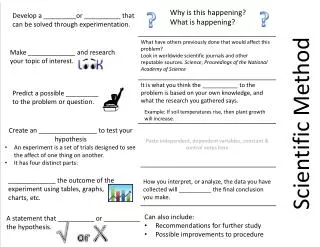
Solving a Problem 1)Identify a Problem 2) State Observations about the problem- Research the problem 3) Form a Hypothesis about the problem (if…then…) 4) Design an Experiment to test the hypothesis 5) Perform the Experiment 6) Collect Data 7) Form a Conclusion 8) Retest