Optimization: Direct Flow Filtration
This guide explores the optimization of direct flow filtration systems, focusing on performance metrics, contaminant types, control levels, and material compatibility. Key factors include processing volume, time, filter size and type, maximum flow rate, and pressure requirements. Understanding the relationship between differential pressure (ΔP) and flow rate is crucial, as ΔP correlates directly to flow at specified filter grades. We also discuss the importance of compliance, validation parameters, and the rationale behind water intrusion testing (WIT) for ensuring optimal filter performance.

Optimization: Direct Flow Filtration
E N D
Presentation Transcript
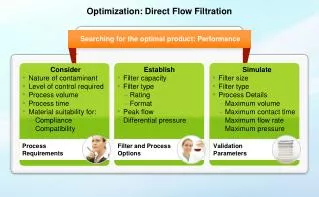
Optimization: Direct Flow Filtration Searching for the optimal product: Performance • Consider • Nature of contaminant • Level of control required • Process volume • Process time • Material suitability for: • Compliance • Compatibility • Simulate • Filter size • Filter type • Process Details • Maximum volume • Maximum contact time • Maximum flow rate • Maximum pressure • Establish • Filter capacity • Filter type • Rating • Format • Peak flow • Differential pressure Process Requirements Filter and Process Options Validation Parameters
Impact of Filter Grades on Flow Vs. ΔP • ΔP is directly proportional to Flow rate (Q) (at a given grade) • ΔP at a given flow rate is generally higher for finer filter grades of the same filter type 12 10 8 Differential Pressure (psi) 6 Flow rate (L/min), water at 20 C per 254 mm (10 in.) Module For liquids other than water, multiply differential pressure by fluid viscosity (cP). 4 2 0 DJL (0.1 µm) DFL (0.2 µm) DBL (0.45 µm)