Download
1 / 22
220 likes | 346 Vues
This comprehensive guide explores ionic compounds, focusing on the fundamental concepts of chemical bonds, and the characteristics of cations and anions. Ionic bonds occur when atoms gain or lose electrons, leading to the formation of charged ions that unite to create stable structures. Key topics include naming conventions, the octet rule, trends in atomic radius and ionization energy, and the physical properties of ionic solids, such as electrical conductivity and melting points. Gain insights into the nature of these compounds and their significance in chemistry.

E N D
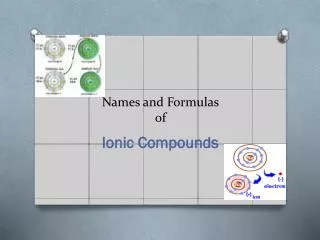
Names and Formulasof Ionic Compounds
Chemical Bonds • The bond is the force that holds two or more atoms together to form a molecule of a compound- two types • Ionic and covalent • Atom is to element as H He Fe Na • Molecule is to compound H2O
Na+ , Cl−, Ca ++ , S = H2SO4 • Formula shown is simplest form of the molecule that is formed when ions combine
Ions • Formed when atoms lose or gain valence electrons • May be + or - ions • They form a stable electron configuration of 8 outer electrons like the noble gases
Cation is + charged ion; loses e- • Anion is – charged ion; gains e- • Ionic bonds form when anion and cations close to each other attract and form a geometric lattice
Force of attraction must be broken to free atoms from each other- usually energy • Physical properties of ionic solids (NaCl salt) like m.p., b.p. hardness, ability to conduct electricity(melted or in solution) attest to strength of bond • Electrolyte: conducts electric current in liquid solution
Atomic Radius • What happens to atoms as they lose electrons? Radius decreases • Opposite? Radius increases • What trends of atomic radius would one expect as atomic number increases? • As one moves from metals to non –metals? • As one moves up and down the table?
Ionization Energy • The energy needed to overcome the attraction between the +positively charged nucleus and the -negatively charged electron • Measured in Joule • Energy required to ionize increases from left to right on pt • Alkali metals –low ionization energies- lose e- readily
Noble gases have EXTREMELY high IE • rare to lose e- • remain stable • He, Ne, Ar, Kr, Xe, Rn
Octet Rule • Atoms tend to lose or gain e- to finalize a full set of 8 valence electrons • This occurs in ionization • Natural occurrence • Makes compound formation possible
PT right side, gain e- - ions or anionsPT left side, lose e- +ions or cations
Electronegativity • Electronegativity is a number that describes the relative ability of an atom, when bonded, to attract electrons.
Where are highest –neg.? • Electronegativity effects properties such as melting and boiling points of substances • Increases from left to right on PT • And decreases from top to bottom
Subscripts in ionic compounds indicate ratio of cations to anions to form electrically neutral atoms H2CO3
Monoatomic ions- form from one atom • -1 is the oxidation state or oxidation number
Polyatomic ions are formed from 2 or more atoms-act as single unit with net charge
Naming • Name of cation first followed by name of anion • NaCl Sodium chloride • Mg SO4 Magnesium sulfate
Charge on cation and anion must = zero for an ionic compound to form • If charge is -1 it can only form bond with other ion +1 • If charge is -2, can form compound with +2 or two ions of +1
Barium Nitrate • Ba (NO3)2 Barium is +2 Nitrate is -1.. (need 2 ions)