SlideServe
Menu
Préférences
© SlideServe · v2026

Art Masterpiece WASSILY KANDINSKY (1866 – 1944) CONCENTRIC CIRCLES

lawrence-oneill avatar
2 diapositives · 214 Views · Nov 17, 2014
Art Masterpiece WASSILY KANDINSKY (1866 – 1944) CONCENTRIC CIRCLES - slide 1
01 / 2Art Masterpiece WASSILY KANDINSKY (1866 – 1944) CONCENTRIC CIRCLES
1 / 17

Télécharger la présentation

Art Masterpiece WASSILY KANDINSKY (1866 – 1944) CONCENTRIC CIRCLES
Une image / un lien ci-dessous est fourni (tel quel) pour télécharger la présentation

Politique de téléchargement : le contenu du site vous est fourni TEL QUEL pour votre information et votre usage personnel ; il ne peut être vendu, concédé sous licence ni partagé sur d’autres sites sans l’accord de son auteur.Le contenu vous est fourni TEL QUEL, pour votre information et votre usage personnel uniquement. Téléchargez la présentation en cliquant sur ce lien. Lors du téléchargement, si vous ne parvenez pas à télécharger une présentation, l’éditeur a peut-être supprimé le fichier de son serveur.Pendant le téléchargement, si vous ne parvenez pas à obtenir une présentation, le fichier a peut-être été supprimé par l’éditeur.

F I N

Plus de contenu associé

Transcription de la présentation
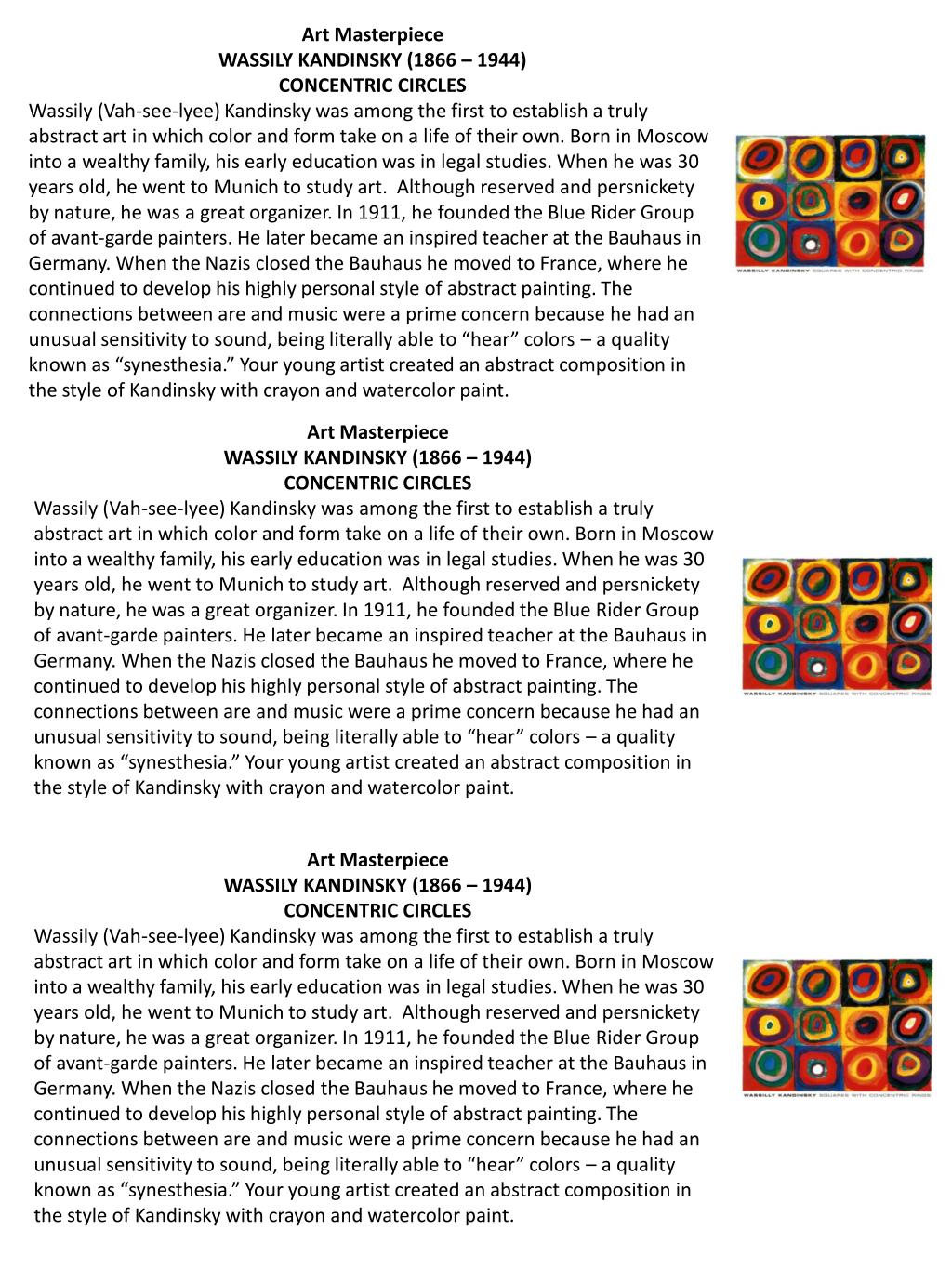
  1. Art Masterpiece WASSILY KANDINSKY (1866 – 1944) CONCENTRIC CIRCLES Wassily (Vah-see-lyee) Kandinsky was among the first to establish a truly abstract art in which color and form take on a life of their own. Born in Moscow into a wealthy family, his early education was in legal studies. When he was 30 years old, he went to Munich to study art. Although reserved and persnickety by nature, he was a great organizer. In 1911, he founded the Blue Rider Group of avant-garde painters. He later became an inspired teacher at the Bauhaus in Germany. When the Nazis closed the Bauhaus he moved to France, where he continued to develop his highly personal style of abstract painting. The connections between are and music were a prime concern because he had an unusual sensitivity to sound, being literally able to “hear” colors – a quality known as “synesthesia.” Your young artist created an abstract composition in the style of Kandinsky with crayon and watercolor paint. Art Masterpiece WASSILY KANDINSKY (1866 – 1944) CONCENTRIC CIRCLES Wassily (Vah-see-lyee) Kandinsky was among the first to establish a truly abstract art in which color and form take on a life of their own. Born in Moscow into a wealthy family, his early education was in legal studies. When he was 30 years old, he went to Munich to study art. Although reserved and persnickety by nature, he was a great organizer. In 1911, he founded the Blue Rider Group of avant-garde painters. He later became an inspired teacher at the Bauhaus in Germany. When the Nazis closed the Bauhaus he moved to France, where he continued to develop his highly personal style of abstract painting. The connections between are and music were a prime concern because he had an unusual sensitivity to sound, being literally able to “hear” colors – a quality known as “synesthesia.” Your young artist created an abstract composition in the style of Kandinsky with crayon and watercolor paint. Art Masterpiece WASSILY KANDINSKY (1866 – 1944) CONCENTRIC CIRCLES Wassily (Vah-see-lyee) Kandinsky was among the first to establish a truly abstract art in which color and form take on a life of their own. Born in Moscow into a wealthy family, his early education was in legal studies. When he was 30 years old, he went to Munich to study art. Although reserved and persnickety by nature, he was a great organizer. In 1911, he founded the Blue Rider Group of avant-garde painters. He later became an inspired teacher at the Bauhaus in Germany. When the Nazis closed the Bauhaus he moved to France, where he continued to develop his highly personal style of abstract painting. The connections between are and music were a prime concern because he had an unusual sensitivity to sound, being literally able to “hear” colors – a quality known as “synesthesia.” Your young artist created an abstract composition in the style of Kandinsky with crayon and watercolor paint.

  2. Art Masterpiece WASSILY KANDINSKY (1866 – 1944) CONCENTRIC CIRCLES Wassily (Vah-see-lyee) Kandinsky was among the first to establish a truly abstract art in which color and form take on a life of their own. Born in Moscow into a wealthy family, his early education was in legal studies. When he was 30 years old, he went to Munich to study art. Although reserved and persnickety by nature, he was a great organizer. In 1911, he founded the Blue Rider Group of avant-garde painters. He later became an inspired teacher at the Bauhaus in Germany. When the Nazis closed the Bauhaus he moved to France, where he continued to develop his highly personal style of abstract painting. The connections between are and music were a prime concern because he had an unusual sensitivity to sound, being literally able to “hear” colors – a quality known as “synesthesia.” Your young artist created an abstract composition in the style of Kandinsky with crayon and watercolor paint. Today in Art Masterpiece, I learned about _____________________ _________________________________________________________ _________________________________________________________ _________________________________________________________ My favorite part was _______________________________________ _________________________________________________________ _________________________________________________________ _________________________________________________________