Key Advances in Surgical Practices: A Historical Overview
120 likes | 240 Vues
Explore the evolution of surgery through distinct historical periods: Prehistoric, Ancient, Medieval, Renaissance, Industrial Age, and the Twentieth Century. Engage with materials that identify significant advances and their chronological context, focusing on contributions from individuals who shaped surgical practices. Investigate key factors such as war, technology, government, trade, chance, and individual genius that have propelled advancements in medicine. Discuss modern improvements, including enhanced anaesthetics, antibiotics, teamwork, resources, keyhole surgery, and microsurgery, and their impact on surgical success rates.


Key Advances in Surgical Practices: A Historical Overview
E N D
Presentation Transcript
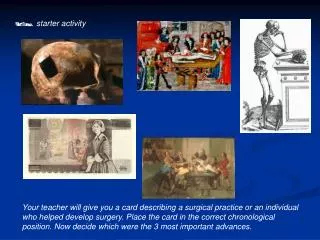
starter activity Your teacher will give you a card describing a surgical practice or an individual who helped develop surgery. Place the card in the correct chronological position. Now decide which were the 3 most important advances.
Advances in surgery • Prehistoric (3000 – 2000 BC) • Ancient (2000 BC – 500 AD) • Medieval (500-1400) • Renaissance (1400-1700) • Industrial Age (1700-1900) • Twentieth Century and beyond The colour code refers to the different periods of surgery we’ve studied D A J G S FM PL OH B N I KC Q E R
Your task • Try to identify factors which helped the advance of medicine: • War • Technology • Government • Trade • Chance • Individual genius
How has surgery developed in recent years? Aims To revise the earlier advances in surgery To identify the key factors which have led to improvements in twentieth century surgery
Your task • Read p. 173-4 and find out the reasons why surgery has improved in recent years. Complete a spider diagram including the following categories: • Improved anaesthetics • Antibiotics • Teamwork • Resources • Keyhole surgery • Microsurgery
Improved anaesthetics • 1930s Helmuth Wesse discovered a method of injecting anaesthetics into blood stream – allowing dosage to be controlled and operations to last longer
Antibiotics • Discovery & mass production of penicillin helped to increase success rate of operations • Led to developments in more complex surgical techniques e.g. transplants and replacement surgery Penicillin tablets – extremely difficult to obtain initially, but now a very common drug
Teamwork • Dr Christian Barnard (below) – doctor who pioneered heart transplant surgery required teams of doctors and who were expert in different fields from anaesthetics to cardiography
Resources • Complex operations very expensive – teams of surgeons, expensive drugs, aftercare etc. • Government and media question how much should be spent on healthcare and where resources should be directed Should the NHS pay for controversial operations like cosmetic surgery?
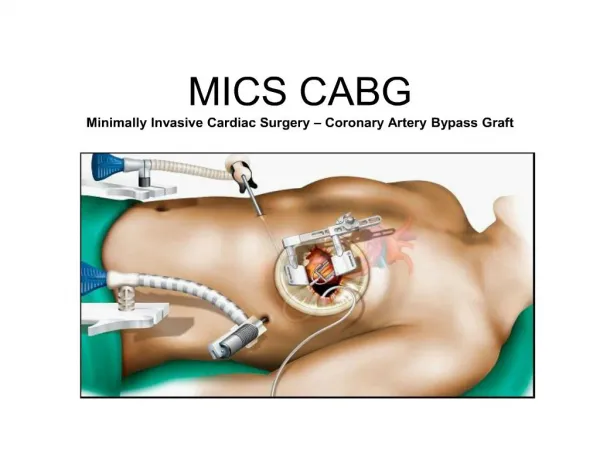
Keyhole surgery • Reduces size of wound created and reduces chance of infection • Fibre-optics and computer-assisted surgery have made this approach possible
Microsurgery • Ability to attach fine blood vessels and nerve endings, e.g. severed limbs This picture shows the limb of a Taiwanese vet which was successfully reattached following an incident at a zoo in Taiwan in 2007
Plenary • What were some of the greatest steps forward in surgery that we have studied? • Why has modern surgery improved so much?