
Energy Transformations and Work: Understanding the Conversion of Energy Forms
E N D
Presentation Transcript
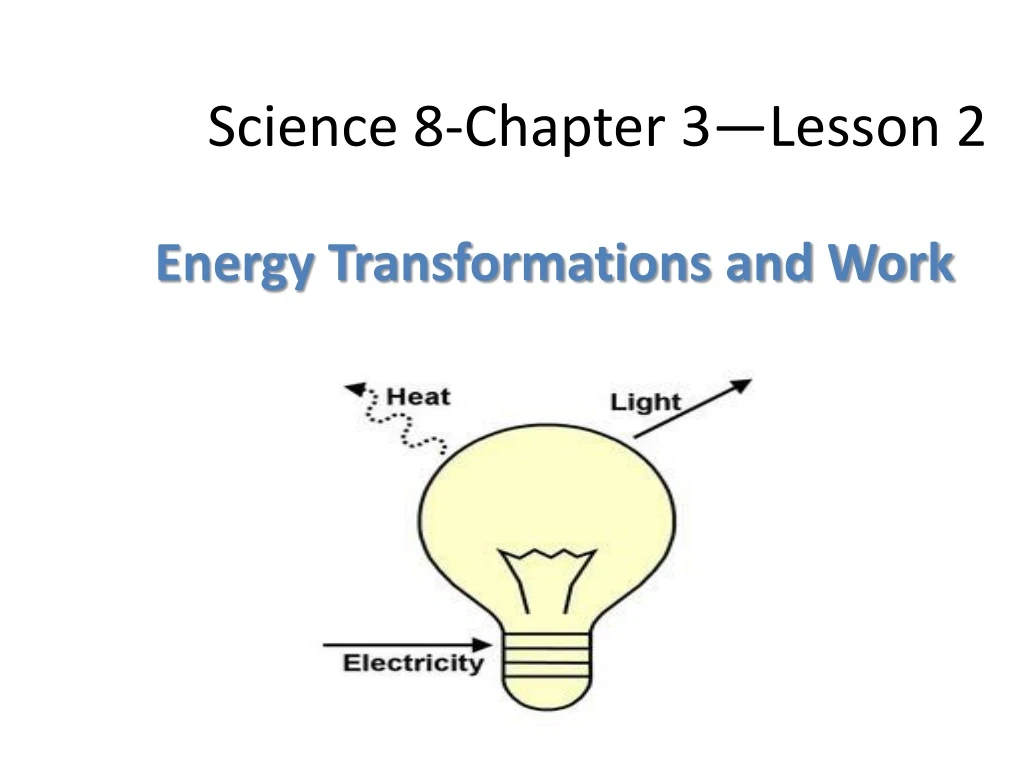
Science 8-Chapter 3—Lesson 2 Energy Transformations and Work
energy can be transformed from one form to another, but it cannot be created or destroyed
law of conservation of energy • energy can be transformed from one form to another, but it cannot be created or destroyed
friction • a force between two surfaces in contact with each other
relating to a natural resource, such as oil or iron ore, that cannot be replaced once it has been used
nonrenewable • relating to a natural resource, such as oil or iron ore, that cannot be replaced once it has been used
a series of chemical reactions that convert light energy, water and carbon dioxide into the food-energy molecule glucose and give off oxygen
photosynthesis • a series of chemical reactions that convert light energy, water and carbon dioxide into the food-energy molecule glucose and give off oxygen
the transfer of energy that occurs when a force makes an object move in the direction of the force while the force acts on the object
work • the transfer of energy that occurs when a force makes an object move in the direction of the force while the force acts on the object
thermal energy moving from a region of higher temperature to a region of lower temperature
heat • thermal energy moving from a region of higher temperature to a region of lower temperature
relating to a natural resource, such as solar energy or wood, that is never used up or that can be replaced by new growth
renewable • relating to a natural resource, such as solar energy or wood, that is never used up or that can be replaced by new growth
energy transformation • the conversion of one form of energy to another