Download
1 / 30
310 likes | 871 Vues
The spinal cord is a vital structure that transmits sensory signals from the periphery to the brain via ascending tracts, while motor impulses are sent from the brain to the body through descending tracts. It plays a crucial role in reflexes, including deep tendon reflexes. Reflex activities occur automatically and protect the body from harm. The reflex arc, composed of sensory neurons, interneurons, and motor neurons, is integral to this process. Abnormalities such as injuries or infections can affect reflex responses, illustrating the importance of spinal cord health.

E N D
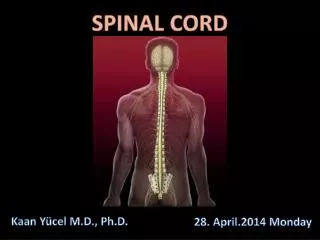
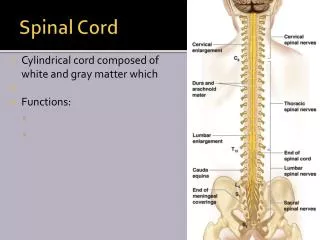
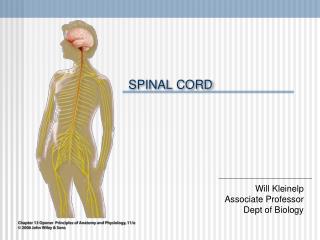
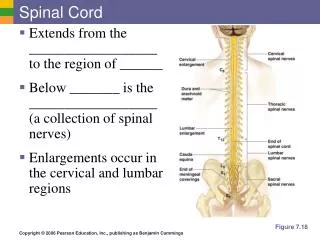
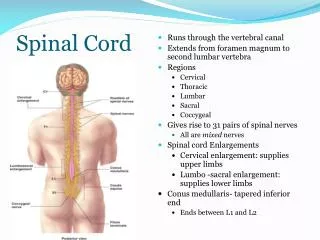
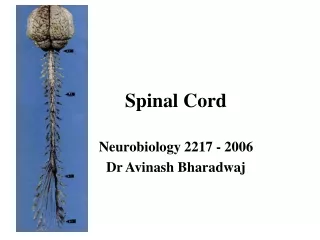
Spinal Cord • The spinal cord is a long, thin, tubular structure made up of nervous tissue, that extends from the medulla oblongata in the brainstem to the lumbar region of the vertebral column
Function • Transmission of sensory signals from periphery to the brain using ascending tracts • Transmission of motor impulses from brain to the periphery using descending tracts • It is the Centre for deep tendon reflexes like knee jerk • Interneurons like renshaw cells help in modulation of motor impulses • Regulation of pain with gate control mechanism • Internal circuits can assist in locomotion
Spinal cord abnormalities • Injury • Complete transection • Hemisection • Syringomylia • Tumours • Infections : tabesdorsalis
Definition • Reflex activity is the response to a peripheral nervous stimulation • It occurs without our consciousness. • It is a type of protective mechanism
Reflex Activity • Example: • When hand is placed on a hot object, it is withdrawn immediately. • When a bright light is thrown into the eyes, eyelids are closed and pupil is constricted to prevent the damage of retina by entrance of excessive light into the eyes.
REFLEX ARC • Reflex arc is the anatomical nervous pathway for a reflex action. • It is the basic unit of integrated reflex activity
REFLEX ARC • A simple reflex arc includes five components • Sense organ (receptor) • An afferent neuron (sensory neuron) • One or more synapses within a central integrating station (centre) • An efferent neuron ( motor neuron) • An effectororgan (muscle).
REFLEX ARC • Receptor • Receptor is the end organ, which receives the stimulus and produces receptor potential. • Afferent Nerve • Afferent or sensory nerve transmits sensory impulses from the receptor to center. • Center • Center receives the sensory impulses via afferent nerve fibers and in turn, it generates appropriate motor impulses. • Center is located in the brain or spinal cord.
REFLEX ARC • Efferent Nerve • Efferent or motor nerve transmits motor impulses from the center to the effector organ. • EffectorOrgan • Effector organ is the structure such as muscle or gland where the activity occurs in response to stimulus.
Clinical classification of reflex • Superficial reflex • Eg: cunjunctival reflex • Deep reflex • Knee jerk • Visceral reflex • Light reflex
Properties of Reflexes Adequate stimulus • Each reflex has a precise stimulus called the adequate stimulus. Irradiation and recruitment ( spatial ): • The extent of the response in a reflex depends on the intensity of the stimulus. Summation • Spatial summation • Temporal summation
Properties of Reflexes Recruitment • If a repetitive stimulus is maintained, the strength of the reflex contraction slowly increases to a final level After-discharge • The reflex response may continue some time after cessation of the stimulus Reciprocal innervation or reciprocal inhibition • Reflex contraction of an agonist muscle is accompanied by inhibition of the antagonist.
Properties of Reflexes Response time • Response time is an indicator of the number of synapses in the reflex arc. Rebound phenomenon • This is the exaggeration of a reflex after a temporary period of inhibition. Fatigue • On repeated stimulation of a reflex for a long time, the response begins to diminish slowly.
Abnormal reflexes • Increased reflexes : injury to brain or spinal cord • Decreased reflexes: injury to spinal nerves • Babinsski sign : injury to pyramidal tract • Pendular jerk: injury to cerebellum