Download
1 / 38
380 likes | 505 Vues
This study explores innovative probabilistic models to enhance fMRI prediction tasks by incorporating temporal and cross-subject data correlations. Utilizing a rich dataset, the models aim to capture dynamic relationships between brain activities reflected in BOLD signals and user ratings over time. The approach involves training on two movies to establish relationships and testing the learned models on new fMRI data. With techniques like regularized linear regression, the research demonstrates how structured voxel selection and correlation analysis can lead to improved prediction accuracy in understanding brain responses to stimuli.

E N D
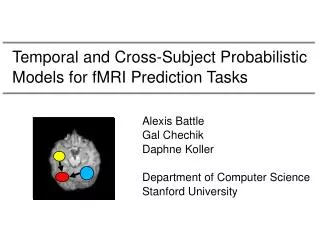
Temporal and Cross-Subject Probabilistic Models for fMRI Prediction Tasks Alexis Battle Gal Chechik Daphne Koller Department of Computer Science Stanford University
PBAI Competition • Provided rich data set • Interesting interactions across time, subjects, and stimuli • Challenged us to come up with reliable techniques • Thanks to the organizers!
Key Points • Predictive voxels selected from whole brain • Probabilistic model makes use of additional correlations • Subjects’ ratings across time steps • Ratings between subjects • Learn strength of each relationship
Modeling the fMRI Domain User Ratings BOLD signal funny tim body language Voxels across time Ratings across time A joint distributionin high dimension
Modeling the fMRI Domain User Ratings BOLD signal funny tim body language Voxels across time Ratings across time A joint distributionin high dimension Training:Use two movies to learn the relations between voxels and ratings
Modeling the fMRI Domain User Ratings BOLD signal funny tim body language Voxels across time Ratings across time A joint distributionin high dimension Testing:Use the learned relations to predict ratings from fMRImeasurements Training:Use two movies to learn the relations between voxels and ratings
Probabilistic Model • Each voxel measurement • Each rating to predict from Vox1 Vox2 Vox3 Language
Probabilistic Model • Each voxel measurement • Each rating to predict • Rating predicted from voxel measurements • Linear regression model (Gaussian distribution) from Vox1 Vox2 Vox3 Language
Probabilistic Model • Each voxel measurement • Each rating to predict • Rating predicted from voxel measurements • Linear regression model (Gaussian distribution) • Selected predictive voxels from whole brain • Regularize (Ridge, Lasso) to handle noise from Vox1 Vox2 Vox3 Language
Probabilistic Model Vox1 Vox2 Vox1 Vox2 … Language Language T =1 T =2
Probabilistic Model • Ratings correlated across time • Language at time 1 makes language at time 2 likely Vox1 Vox2 Vox1 Vox2 … Language Language T =1 T =2
Probabilistic Model • Ratings correlated across time • Language at time 1 makes language at time 2 likely Vox1 Vox2 Vox1 Vox2 … Language Language T =1 T =2
Probabilistic Model A*Lang (1)*Lang(2) • Ratings correlated across time • Language at time 1 makes language at time 2 likely • Weight A – how correlated? Vox1 Vox2 Vox1 Vox2 A … Language Language T =1 T =2
Probabilistic Model Vox1 Vox2 Vox1 Vox2 Language Language Subject 1 Vox1 Vox2 Vox1 Vox2 Language Language Subject2 … T =2 T =1
Probabilistic Model Vox1 Vox2 Vox1 Vox2 • Ratings likely to be correlated between subjects Language Language Subject 1 Vox1 Vox2 Vox1 Vox2 Language Language Subject2 … T =2 T =1
Probabilistic Model Vox1 Vox2 Vox1 Vox2 • Ratings likely to be correlated between subjects • Weighted correlation, NOT equality Language Language Subject 1 B Vox1 Vox2 Vox1 Vox2 B Language Language Subject2 … T =2 T =1
Probabilistic Model Joint model over all time points: Sub1 … Sub2 Time Gaussian Markov Random Field – joint Gaussian over all rating nodes conditioned on voxel data
Voxel Parameters Vox1 Vox2 Vox3 • Regularized linear regression for voxel parameters Language
Voxel Parameters Vox1 Vox2 Vox3 • Regularized linear regression for voxel parameters Language
Voxel Parameters Vox1 Vox2 Vox3 • Regularized linear regression for voxel parameters Language β1= 0.45 β2 = 0.55
Inter-Rating parameters • Other weights also learned from data • Example: cross-subject weights Vox1 Vox2 L(1) B Vox1 Vox2 L(2) C = 0.6
Inter-Rating parameters • Other weights also learned from data • Example: cross-subject weights Vox1 Vox2 Faces Attention L(1) B Vox1 Vox2 L(2) C = 0.6
Inter-Rating parameters • Other weights also learned from data • Example: cross-subject weights Vox1 Vox2 Faces Attention L(1) B Vox1 Vox2 L(2) B = 0.3 B = 0.7 C = 0.6
Prediction Results • Use full learned model, including all weights • Predict ratings for a new movie given fMRI data
Prediction Results • Use full learned model, including all weights • Predict ratings for a new movie given fMRI data
Prediction Results • Comparison to models without time or subject interactions
Voxel Selection • Voxels selected by correlation with rating • Number of voxels determined by cross-validation
Voxel Selection • Voxels selected by correlation with rating • Number of voxels determined by cross-validation
Selected Voxels L L Faces Language
Selected Voxels L L Motion Arousal
Voxel Selection • Voxels selected for Language included some in ‘Face’ regions: L
Voxel Selection • Voxels selected for Language included some in ‘Face’ regions: L • Language and face stimuli correlated in videos • Complex, interwoven stimuli affect voxel specificity
Voxel Selection • Voxel selection extension – “spatial bias” • Prefer grouped voxels 0.33 0.38 * after competition submission
Voxel Selection • Voxel selection extension – “spatial bias” • Prefer grouped voxels 0.33 0.38 * after competition submission
Voxel Selection • Voxel selection extension – “spatial bias” • Prefer grouped voxels • Additional terms in linear regression objective: • |β1| |β2| D(Vox1, Vox2) 0.33 0.38 D || Vox1 –Vox2||2 * after competition submission
Adding Spatial Bias L L Faces
Conclusions • Reliable prediction of subjective ratings from fMRI data • Time step correlations aid in prediction reliability • Cross-subject correlations also beneficial • Individual voxels selected from whole brain • Reliability from regularization • Some found in expected regions • Some “cross-over” for correlated prediction tasks
Comments? • Poster #675 • ajbattle@cs.stanford.edu