The Fall of Tsarist Russia: Key Events Leading to the 1917 Revolution
This overview of Tsarist Russia from 1924 to 1957 highlights key historical events that led to the 1917 revolution. Focusing on the impact of Tsar Nicholas II, the influence of Grigori Rasputin, and the challenges faced during World War I, the piece examines the socio-economic disparity between the rich and the poor and the political unrest that culminated in the abdication of Tsar Nicholas. From the struggles of soldiers to the bread riots in Petrograd, discover how these elements contributed to the fall of the monarchy and the birth of a new era in Russian history.

The Fall of Tsarist Russia: Key Events Leading to the 1917 Revolution
E N D
Presentation Transcript
USSR 1924-57 INTRODUCTION
First impressions! • When you hear the word “Russia:” What do you think of? Write down two things that come to mind • http://www.youtube.com/watch?v=6g4qk8VHyTY&feature=related
Geography Covers more than a ninth of the earth’s land area Is 17 075 400 Square kilometres in size Spans over 9 different time zones
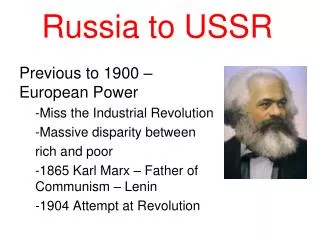
General History • From the earliest beginnings of the Russian State, Russia was ruled by Tsars. • Tsars had absolute power, which meant they did not have to answer to anybody • Under this strong rule, Russia grew into a large empire but was very backward compared to the rest of Western Europe. There was a vast disparity between rich and poor.
Task: • Read the worksheet on Peasants and Factory workers. • Condense the information into concise notes in the form of a T chart • On page 12 of the Text book, draw the diagram showing society in Tsarist Russia
Nicholas II was the last Tsar of Russia. He did not care for politics and was oblivious to the plight of his people. • His son, Alexei the Tsarevich (heir to the throne) had the disorder called haemophilia (this means your blood doesn’t clot, so the smallest cut could kill) • Nicholas turned to a Siberian ‘healer’ called Gregori Rasputin to help. Rasputin soon became a regular visitor to the Royal household, and his influence in political affairs started to show
When World War One broke out in 1914, the country was united with the Tsar to fight Germany. • Soldiers were badly trained and poorly equipped. Russia was not industrialised enough to win a modern war. The Russian army suffered horrendous defeats. • Tsar Nicholas decided to go to the front and lead the army. This was one of his worst decisions, as this made him responsible for the defeats AND the shortages
While Nicholas was away at the front, his wife Alexandria took over running Russia, with disastrous consequences • Alexandria had been born in Germany, so the Russian people became uneasy at her power • She relied heavily on advice from Rasputin, who was a serial alcoholic and womaniser. • The Russian people did not trust Alexandria or Rasputin, and rumours began to circulate that they were seeing each other
In 1916, a group of nobles decided to kill Rasputin, to help Russia’s cause • They lured him to one of their homes, and served him cakes and red wine laced with enough cyanide to kill 5 men. Rasputin was completely unaffected! • The nobles then shot him, and he still didn’t die, so they shot him 3 more times, bound him up and threw him in the River Neva • The autopsy showed that Rasputin had died from drowning, not his injuries!!!
By 1917, there had been more than 6 million Russian Casualties. • The cities were starving, and in February 1917 bread riots in Petrograd led to a general strike. • The Tsar’s troops refused to shoot the rioters, and Nicholas realised that there was no one to keep him on the throne, so he abdicated….
http://www.youtube.com/watch?v=QxAUQnh8-4o&feature=related • http://www.youtube.com/watch?v=C6v8JM4Fe1