

SlideServe
Menu
Préférences
© SlideServe · v2026

Hacer ahora

leif avatar
13 diapositives · 319 Views · Oct 04, 2014

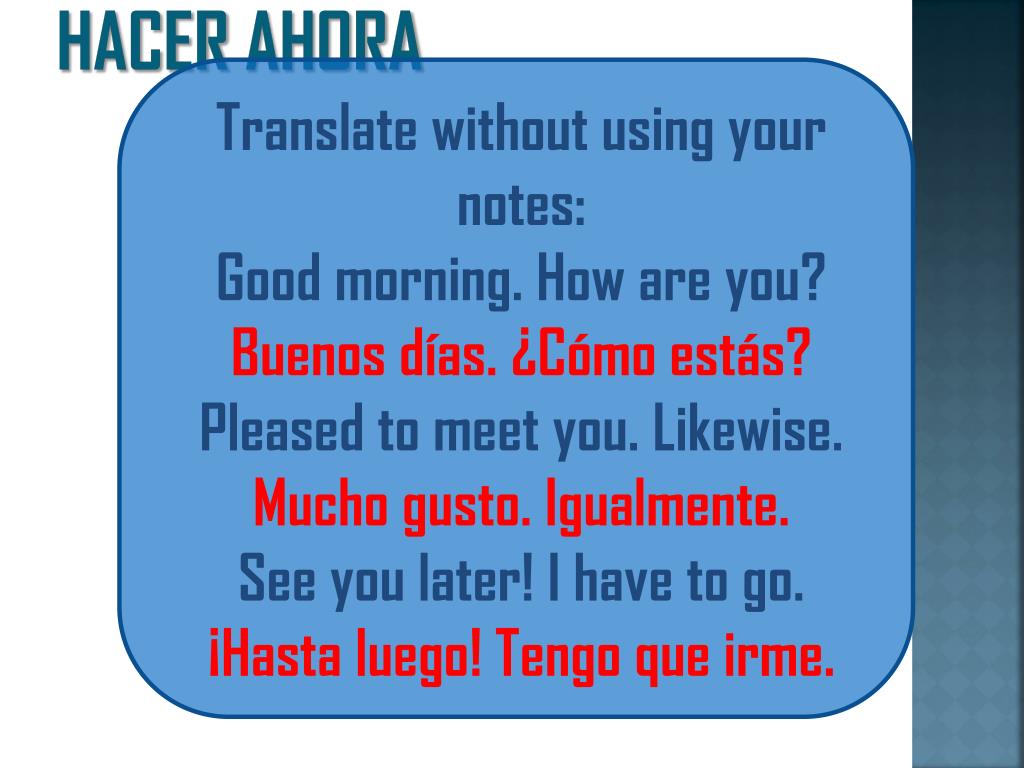
Hacer ahora. Translate without using your notes: Good morning. How are you? Buenos días . ¿ Cómo estás ? Pleased to meet you. Likewise. Mucho gusto. Igualmente . See you later! I have to go. ¡Hasta luego ! Tengo que irme. Asking how someone is. To ask how someone is:
Hacer ahora - slide 1
01 / 13Hacer ahora
1 / 17

Télécharger la présentation

Hacer ahora
Une image / un lien ci-dessous est fourni (tel quel) pour télécharger la présentation

Politique de téléchargement : le contenu du site vous est fourni TEL QUEL pour votre information et votre usage personnel ; il ne peut être vendu, concédé sous licence ni partagé sur d’autres sites sans l’accord de son auteur.Le contenu vous est fourni TEL QUEL, pour votre information et votre usage personnel uniquement. Téléchargez la présentation en cliquant sur ce lien. Lors du téléchargement, si vous ne parvenez pas à télécharger une présentation, l’éditeur a peut-être supprimé le fichier de son serveur.Pendant le téléchargement, si vous ne parvenez pas à obtenir une présentation, le fichier a peut-être été supprimé par l’éditeur.

F I N

Plus de contenu associé

Transcription de la présentation
  1. Hacerahora Translate without using your notes: Good morning. How are you? Buenos días. ¿Cómoestás? Pleased to meet you. Likewise. Mucho gusto. Igualmente. See you later! I have to go. ¡Hasta luego! Tengoqueirme.

  2. Asking how someone is • To ask how someone is: • ¿Cómo estás?  How are you? • ¿Qué tal?  How’s it going? • ¿Y tú?  And you?

  3. Saying how you are • To answer: • Estoy bien.  I’m well. • Regular.  Okay. • Estupendo/a  Great. • Excelente.  Excellent/Great. • Más o menos.  So-so. • Muy mal.  Very bad. • ¡Horrible!  Horrible!

  4. La tarea • Act. 7 • 1. Regular. Estoy bien, gracias. Más o menos. • 2. same as above. • 3. same as above. • 4., 5. ¿Cómo estás? or ¿Qué tal?

  5. La tarea • Act. 9 • 1. e • 2. f • 3. a • 4. b, d • 5. d, b

  6. La tarea • Act. 10 • 1. Hola, ¿Qué tal?, Buenos días, etc. • 2. Me llamo…., Soy…. • 3. Mucho gusto. • 4. Tengo que irme. • 5. Bueno, tengo clase. • 6. Estoy bien.

  7. Yotú Yo = I Tú = you (one person) In Spanish the subject is implied by the verb form. Ex. Estoy bien. Yo estoy bien. = I am fine ¿Cómo estás? ¿Cómo estás tú? = How are you?

  8. Complete Act. 8, page 3 in the Cuaderno de Gramática: • tú - estás • yo - Estoy • tú - te llamas • yo - Me llamo • yo - Soy • yo - Tengo • yo - Tengo

  9. Correct the punctuation in these phrases. • Buenos dias • Adios • Hasta manana • Como te llamas • Como estas hoy • Y tu • Que tal • senora • Este es mi amigo, Pablo ¡Buenos días! Adiós. Hasta mañana. ¿Cómo te llamas? ¿Cómo estás hoy? ¿Y tú? ¿Qué tal? señora Éste es mi amigo, Pablo.

  10. Repaso del vocabulario What’s your name? I’m well/good. ¿Cómote llamas? Me too. Estoybien. Same here. Delighted/ nice to meet you (female) Yotambién. I am… Delighted/nice to meet you (male) Igualmente His/her name is… Encantado. This is my (female) friend… Encantada. See you soon. Yo soy... Bye. Se llama… Ésta es mi amiga… Chao. Hasta pronto.

  11. In the Cuaderno de Actividades: Page 4 – 6, # 3, 4, 5, 7

  12. Traducir • First 3 people to translate the entire conversation PERFECTLY wins candy Juan: Hola, buenos días. Marta: Hola. ¿Cómo estás? Juan: ¡Yo estoy bien! ¿Y tú? Marta: Más o menos. Bueno, tengo clase. Juan: Hasta pronto.

  13. Row Game • Translate: Ésta es mi amiga. • Write missing punctuation: Como te llamas • Write missing punctuation: Que tal • Write missing punctuation: Como estas tu • Translate: Igualmente. • What is the difference between “encantado” and “encantada”? • Why are accent marks used in Spanish? • Write in Spanish: I am • Write in Spanish: How are you? • Write in Spanish: his/her name is