Key Factors in Pricing Strategies for New Products and Market Competitiveness
Understanding the various factors affecting product pricing is crucial for effective market strategies. Key considerations include product costs—using cost-based methods and desired profit margins—and target market analysis to ensure competitive positioning. Companies need to evaluate both direct costs and target ROI to determine optimal pricing structures. The target profit pricing formula guides businesses in setting prices that cover overall expenses and align with market demand. Case studies such as MangKikoy's water refilling station and Penshoppe's new shirt designs illustrate the practical application of these pricing strategies.

Key Factors in Pricing Strategies for New Products and Market Competitiveness
E N D
Presentation Transcript
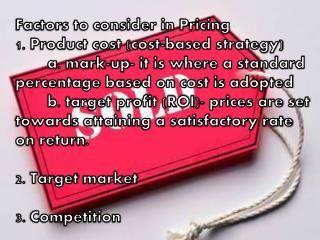
Factors to consider in Pricing1. Product cost (cost-based strategy) a. mark-up- it is where a standard percentage based on cost is adopted b. target profit (ROI)- prices are set towards attaining a satisfactory rate on return.2. Target market3. Competition
Target profit pricing formula: Target profit pricing= Unit cost + Target ROI x Investment Unit Sales
Unit cost formula: Unit cost pricing= Over- all expenses Target sales volume (based on market segmentation) • Variable + cost
Example : MangKikoy is planning to put up a water refilling station. Using the following information, compute the right price of the new product of MangKiko.
Let’s try: Penshoppe Inc. is planning to sell new designs of shirt. Using the following information, compute for the price of the new product of Penshoppe.
![UNIT-25 COCOMO [CONSTRUCTIVE COST MODEL]](https://cdn4.slideserve.com/672242/slide1-dt.jpg)