Understanding Shifts in Aggregate Supply: SRAS, LRAS, and Short-Run Equilibrium Dynamics
This overview explains the dynamics of Short-Run Aggregate Supply (SRAS) and Long-Run Aggregate Supply (LRAS), focusing on how various factors cause shifts in these curves. In the short run, output fluctuates due to deviations in actual from expected price levels. Long-run adjustments occur when wages and prices stabilize, influenced by changes in production factors like labor, capital, natural resources, technology, and government incentives. Understanding these shifts is vital for analyzing economic conditions, particularly during significant historical economic phases.

Understanding Shifts in Aggregate Supply: SRAS, LRAS, and Short-Run Equilibrium Dynamics
E N D
Presentation Transcript
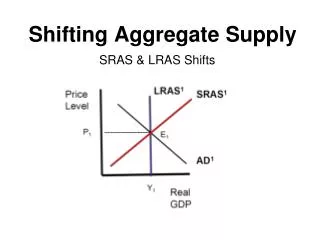
Shifting Aggregate Supply SRAS & LRAS Shifts
Short Run Equilibrium • Output deviates only in short run when actual price level deviates from expected price level • In long run, wages & prices are not “sticky” and do not affect output (price level has no effect) • Prices/wages become flexible!
Shifts in LRAS Curve • Shifts occur when a factors of production changes: • Labor • Capital • Natural resources • Technology • Government Incentives • Why: Any change which alters the natural rate of outputshifts the LRAS curve • When LRAS shifts so does SRAS
Shifts in the Long Run Aggregate Supply Curve (LRAS) LABORCAPITAL NATURAL TECHNOLOGY RESOURCES Discovery of new resources Change in old resources Increase in Labor Force Change in Natural Rate of Unemployment New Technology More Free Trade Any Shift in Capital Stock Physical capital or Human capital
Changes in Government Policy which provide incentives to invest in capital stock or technology shift LRAS right PPF Graph Price Level LRAS2 LRAS1 Why the USA had a strong Economy during 1980’s & 1990’s Real GDP Y1 Y2 Recent History: The 1980’s & 1990’s Technology Breakthroughs occur in USA Economy
Shifts in SRAS Curve • Shifts occur when with a change in: • Expected Price Level • Input Prices • Labor • Capital • Natural resources • Technology • Gov’t Incentives Shift SRAS but NOT LRAS Changes in the other 5 variables Shifts BOTH curves (LRAS & SRAS)
Shifting SRAS Event: Input prices suddenly rise
Buy American Video • Got Flexible Prices?
Expected Price Level (inflation) • Increase in expected price level: • Shifts the SRAS curve to left (less supply) • Decrease in expected price level: • shifts SRAS curve to right (more supply) Rise in Expected Inflation will result in workers demanding higher pay Costs rise => Less is Supplied
1. An increase in expected price Level causes a shift . . . SRAS2 SRAS1 B P2 A P 3. . . . and the price level to rise. AD1 Y2 Y 2. . . . causes output to fall . . . Example: Increase in Price Level Price Level . ……………. Real GDP 0
LRAS1 LRAS2 Price Level Real GDP Variables that shift AS: Increase in any variable will shift PPF curve out 1. Labor Force 2. Natural resources 3. Capital 4. Technology 5. Gov’t Incentives