
Convolution and Edge Detection in Image Processing
E N D
Presentation Transcript
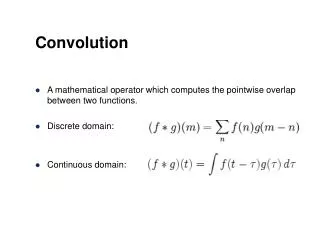
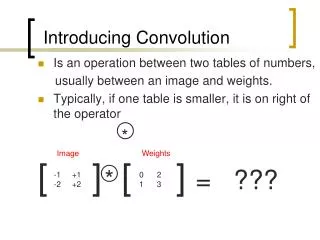
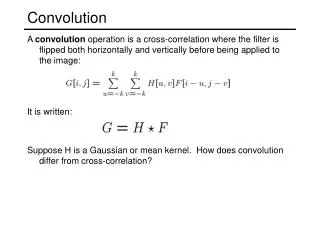
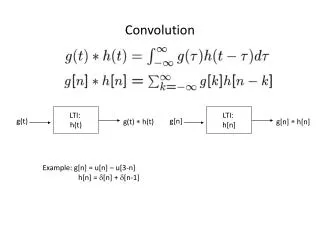
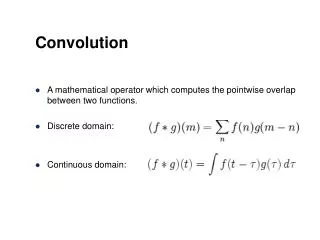
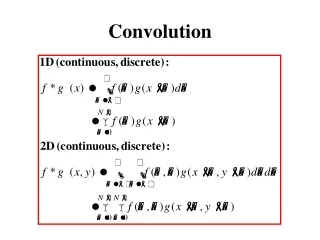
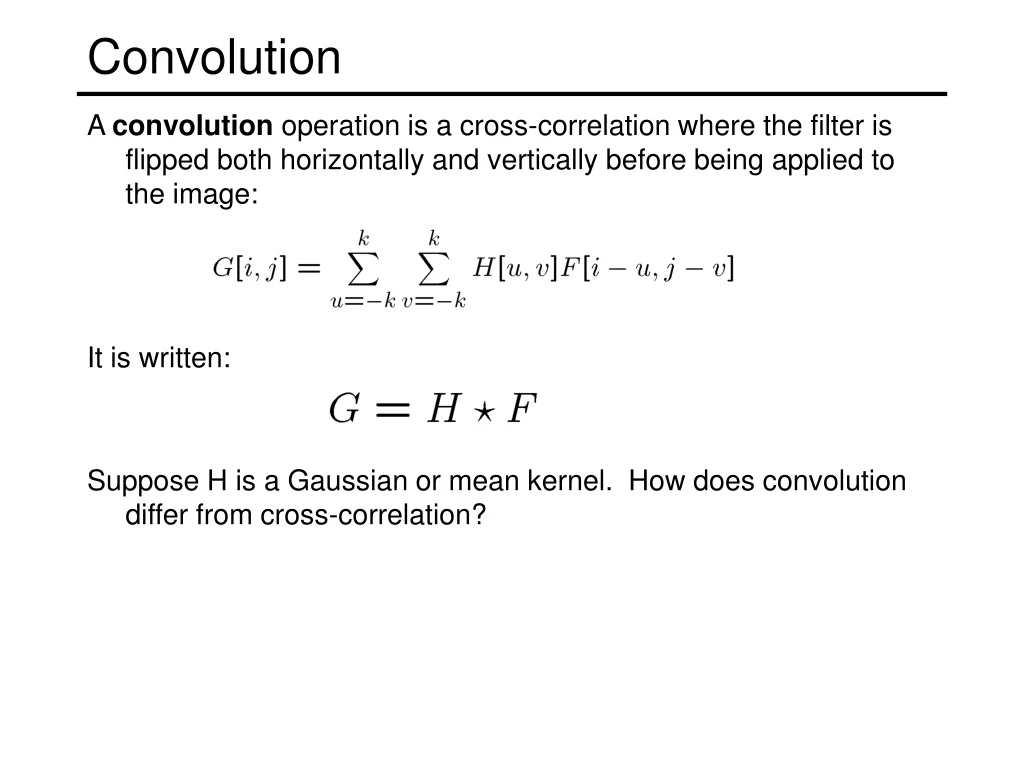
Convolution • A convolution operation is a cross-correlation where the filter is flipped both horizontally and vertically before being applied to the image: • It is written: • Suppose H is a Gaussian or mean kernel. How does convolution differ from cross-correlation?
Continuous filtering • We can also apply continuous filters to continuous images. • In the case of cross correlation: • In the case of convolution: • Note that the image and filter are infinite.
The gradient direction is given by: • how does this relate to the direction of the edge? • The edge strength is given by the gradient magnitude Image gradient • The gradient of an image: • The gradient points in the direction of most rapid change in intensity
Effects of noise • Consider a single row or column of the image • Plotting intensity as a function of position gives a signal • Where is the edge?
Look for peaks in Solution: smooth first • Where is the edge?
Derivative theorem of convolution • This saves us one operation:
Laplacian of Gaussian • Consider Laplacian of Gaussian operator • Where is the edge? • Zero-crossings of bottom graph
Laplacian of Gaussian • is the Laplacian operator: 2D edge detection filters Gaussian derivative of Gaussian filter demo
Edge detection by subtraction original
Edge detection by subtraction smoothed (5x5 Gaussian)
Edge detection by subtraction Why does this work? smoothed – original (scaled by 4, offset +128) filter demo
Gaussian - image filter Gaussian delta function Laplacian of Gaussian