Origins and Impact of Progressivism (1890-1920): A Look at Reforms and Suffrage
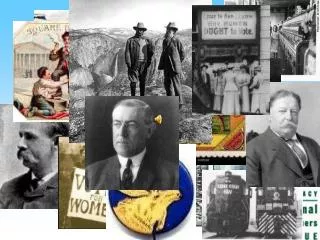
The Progressive Era (1890-1920) marked a period of widespread reforms aimed at addressing social injustices and government accountability. Figures like Upton Sinclair and reformers such as Henry George and Edward Bellamy influenced public opinion on labor rights and poverty. Key legislation addressed child labor and improved working conditions. Political figures like Theodore Roosevelt and Woodrow Wilson furthered these reforms. The fight for women's suffrage, championed by leaders like Susan B. Anthony and Carrie Chapman Catt, culminated in the 19th Amendment, granting women the right to vote.

Origins and Impact of Progressivism (1890-1920): A Look at Reforms and Suffrage
E N D
Presentation Transcript
Chapter 11 The Progressive Reform Era
Section 1- Origins of Progressivism • Progressive Era refers to the period from 1890-1920 where a variety of reforms were enacted • Rapid industrialization Pg. 383
Progressives • Focus mainly on helping the poor and the industrial workers • The Gov should be more accountable for the citizens • Less Gov corruption • More child labor Laws • Did not seek a ban on strikes, Labor Unions? Pg. 383
Injunctions- court orders that prohibit a certain activity • Usually prevented workers from going on strike Pg. 385
Reformers • Henry George and Edward Bellamy were both journalists • George wrote Progress and Poverty and Bellamy wrote Looking Backward • Their ideas influenced the Populists Party Platform in 1892 • George and Bellamy both wrote about ideas for reforming society Pg. 384
Upton Sinclair • Muckrakers • The Jungle- poverty, living/working conditions, and lack of hygiene during the Progressive Era Pg. 385
Florence Kelly • Prohibiting child labor, limiting worker hours, and regulating sweatshop conditions in Illinois in 1893 • Why would some people not like progressives? Pg. 386
Section 2- Progressive Legislation • Social welfare programs- ? • September 8, 1900 a hurricane hit Galveston killing 6,000 people in 18 hrs • The city created an emergency commission of 5 appointed administrators • Pg. 390
Power to the People • Robert La Follete • Direct primary- an election which citizens vote to select nominees for elections • Referendum- voters can vote on bills directly • Initiative • Recall Pg. 392
TR as President • 1902, United Mine Workers called a strike and TR called for arbitration • “square deal” • Cracked down on big businesses • Set aside 200 million acres for national forests • Regulated food and drugs Pg. 394-395
GREAT SMOKEY MOUNTAIN NATIONAL PARK- NORTH CAROLINA
ROCKY MOUNTAIN NATIONAL PARK- COLORADO
Section 3- Progressivism Under Taft and Wilson • Taft is President- 1908 • Taft chose Richard Ballinger for Sec of Interior (oversees National Park Service) • Ballinger upset conservationists- ? • Republicans were angry at Taft because the Ballinger-Pinchot affair Pg. 396-397
The Election of 1912 • Taft, Roosevelt, Wilson • Progressive Party or the Bull Moose Party • Oct. 14 in Milwaukee, TR was shot • “Friends, I shall ask you to be as quiet as possible. I don’t know whether you fully understand that I have just been shot; but it takes more than that to kill a Bull Moose” • TR and Taft ended up splitting Republican votes • Pg. 397
Wilson wins election • Federal Reserve System- Woodrow Wilson • 12 districts • Why did Progressivism die after Wilson’s 2nd term? Pg. 400-403
Section 4- Suffrage at Last • Civil Disobedience Susan B. Anthony and Elizabeth Cady Stanton Anthony was arrested in 1872 when she led women to the poles in NY to vote, fined $100 Pg. 404
1890, National American Woman Suffrage Association (NAWSA) • by this time, women could buy, sell, and will property • The women’s right to vote failed again and again, after Stanton and Anthony died, it was up to a new generation to gain the right to vote • Pg. 405-406
Carrie Chapman Catt and Alice Paul became the new leaders in women’s suffrage • Paul organized a parade of 5000 in Washington DC • Aggressive militant approach caused a split Pg. 406
Catt continued on with NAWSA and ended up gaining lots support, even winning suffrage in New York • With the U.S. entering WWI in 1917, women • volunteered with medical help and took over jobs left • by men • Suffrage Support? • Pg. 406-407
Carrie Chapman Catt lead NAWSA to victoryand eventually to the end of women’s suffrage • 1919, 19th Amendment? • “It is doubtful that any man…ever realized what the suffrage struggle came to mean to women…It leaves a mark on one, such a struggle.”