Analysis of JTIDS Interference Impact on High-Altitude State Vector Update Times
This document presents a detailed analysis of the JTIDS interference effects on State Vector Update times for various receiver configurations at high altitudes. It evaluates multiple altitude options, including FL150, alongside ground receiver performance metrics. The study examines how diversity and switched receivers with different frequency filters (0.8 MHz and 1.2 MHz) respond under different interference conditions. Results highlight the nuances of receiver performance at varying flight levels and transmission power levels, providing insight into optimizing air traffic management systems.

Analysis of JTIDS Interference Impact on High-Altitude State Vector Update Times
E N D
Presentation Transcript
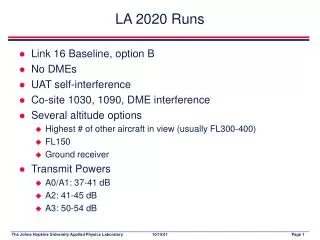
LA 2020 Runs • Link 16 Baseline, option B • No DMEs • UAT self-interference • Co-site 1030, 1090, DME interference • Several altitude options • Highest # of other aircraft in view (usually FL300-400) • FL150 • Ground receiver • Transmit Powers • A0/A1: 37-41 dB • A2: 41-45 dB • A3: 50-54 dB
LA 2020 Runs II • Several receiver configuration options • Diversity receivers • Switched receiver • A0: bottom antenna only • A0 restrictions • Up to FL150 • Transmits on bottom antenna only • Receive filters • Diversity receivers have both 0.8 MHz and 1.2 MHz • Switched/A0 (bottom) have 1.2 MHz only
Impact of JTIDS Interference on State Vector Update Times for a Diversity Receiver at High Altitude with 1.2 MHz Filter
State Vector Update Times for Diversity Receiver at High Altitude
State Vector Update Times for Diversity Receiver at FL 150 with a 1.2 MHz Filter
TCP Update Times for Diversity Receiver at FL 150 with a 1.2 MHz Filter
State Vector Update Times for Switched Receiver at High Altitude
State Vector Update Times for A0 (bottom only) Receiver at FL 150