Overview of East Asia: Geography, Climate, and Socioeconomic Factors
100 likes | 220 Vues
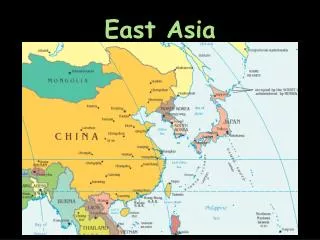
East Asia is defined by its unique geographical features, such as Japan's volcanic archipelago, the towering mountains referred to as the "Roof of the World," and the significant loess deposits shaped by the Yellow River. China stands out as the world's largest coal producer, with only 10% of its land suitable for farming. The region is affected by seasonal monsoons and intense typhoons, creating distinct climate patterns. Japan's industrialized society is characterized by megacities, high incomes, and scarce farmland, while religious beliefs, including Buddhism and Shinto, play significant roles in cultural identity.


Overview of East Asia: Geography, Climate, and Socioeconomic Factors
E N D
Presentation Transcript
I. Archipelago - group of islands. • A. Japan • 1. created by volcanoes • 2. Fifty or more still active
II. Mountains • A. “Roof of the World” • 1. Five major mountain systems in Western Asia form border for continent. • 2. Peaks of 25,000 ft. or taller.
III. Loess • A. Yellowish brown topsoil carried by the Yellow River • 1. dust from the western deserts http://www.gvc.gu.se/ngeo/ng-hem/china/excursion/loess.htm
IV. China • A. Largest coal producer in the world • B. Only 10% of the land is arable
V. Monsoons • A. Seasonal winds • 1. Summer – Hot, humid air from Pacific • 2. Winter – Cold, dry wind from Siberia
VI. Typhoons • A. Violent hurricanes from Aug.-Oct. http://www.aoml.noaa.gov/hrd/tcfaq/A1.html
VII. Gobi Desert • A. Hot in summer, cold in winter • 1. Winter average temp. is 10 F.
VIII. Japan • A. Highly industrialized • 1. Megalopolis – Super city including Tokyo and Yokohama • 2. Housing shortages • 3. High incomes • a)1997 avg. household income = $61,597. • 4. Scarce farmland
IX. Religion • A. Japan – Buddhism and Shinto • B. China and N. Korea – Communists discouraged any. http://www.aerobatics.ws/GEI/japan.html