SlideServe
Menu
Préférences
© SlideServe · v2026

Advancements in Atmospheric Measurement: Variability, Sensitivity, and Aerosol Subgroup Insights

linore avatar
7 diapositives · 226 Views · Aug 04, 2014

This report discusses recent progress in atmospheric studies focusing on the variability and sensitivity of trace gases and aerosols. Key findings highlight the importance of high-resolution measurements for capturing regional variations and improving retrieval sensitivity, particularly for O3 and CO. The report outlines current challenges, including the need for cloud-clearing techniques and efficient mission planning. Emphasizing collaborative international efforts, the study aims for compelling scientific outcomes to strengthen community support and enhance the feasibility of future atmospheric missions.
Advancements in Atmospheric Measurement: Variability, Sensitivity, and Aerosol Subgroup Insights - slide 1
01 / 7Advancements in Atmospheric Measurement: Variability, Sensitivity, and Aerosol Subgroup Insights
1 / 17

Télécharger la présentation

Advancements in Atmospheric Measurement: Variability, Sensitivity, and Aerosol Subgroup Insights
Une image / un lien ci-dessous est fourni (tel quel) pour télécharger la présentation

Politique de téléchargement : le contenu du site vous est fourni TEL QUEL pour votre information et votre usage personnel ; il ne peut être vendu, concédé sous licence ni partagé sur d’autres sites sans l’accord de son auteur.Le contenu vous est fourni TEL QUEL, pour votre information et votre usage personnel uniquement. Téléchargez la présentation en cliquant sur ce lien. Lors du téléchargement, si vous ne parvenez pas à télécharger une présentation, l’éditeur a peut-être supprimé le fichier de son serveur.Pendant le téléchargement, si vous ne parvenez pas à obtenir une présentation, le fichier a peut-être été supprimé par l’éditeur.

F I N

Plus de contenu associé

Transcription de la présentation
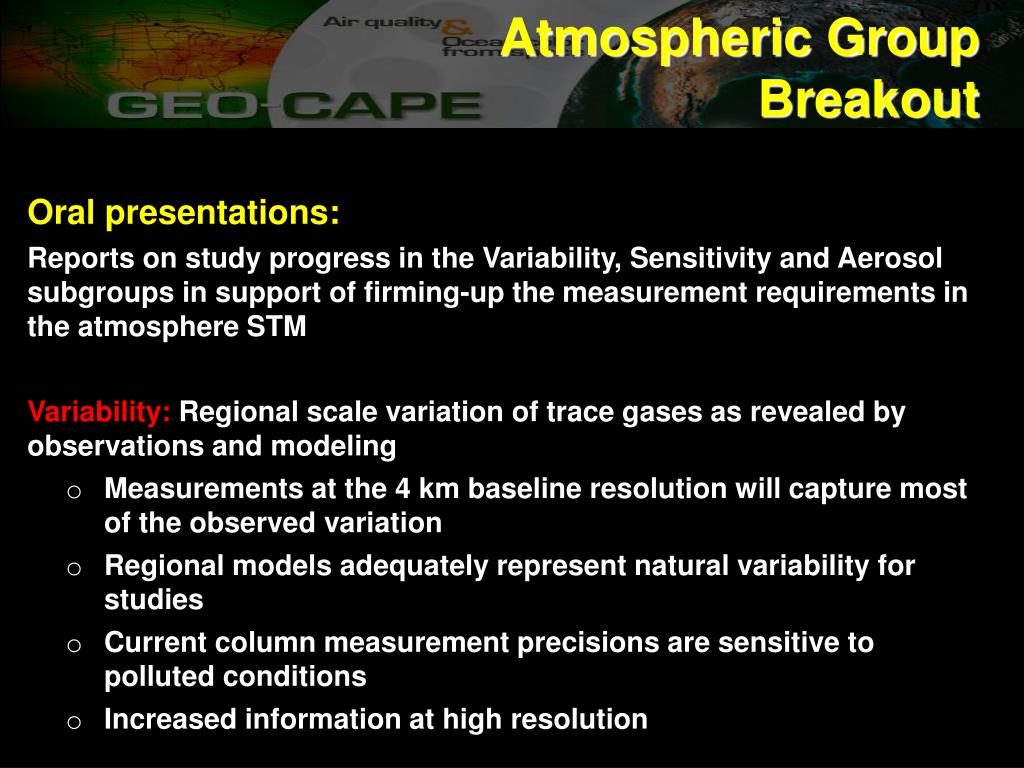
  1. Atmospheric Group Breakout • Oral presentations: • Reports on study progress in the Variability, Sensitivity and Aerosol subgroups in support of firming-up the measurement requirements in the atmosphere STM • Variability: Regional scale variation of trace gases as revealed by observations and modeling • Measurements at the 4 km baseline resolution will capture most of the observed variation • Regional models adequately represent natural variability for studies • Current column measurement precisions are sensitive to polluted conditions • Increased information at high resolution

  2. Atmospheric Group Breakout • Vertical sensitivity: Vertical correlations; use of multispectral retrievals to improve sensitivity to the lowermost troposphere • Good progress demonstrating improved O3 retrieval sensitivity both in simulations and using actual observations • Capability clearly demonstrated for CO • More work needed to generalize case studies • Vertical correlations; vertical structure • Cross-species correlations • Aerosol: Pixel resolution, aerosol retrieval availability and cloud avoidance • Baseline 2-km pixel resolution is required for an 8 km AOD product • Cloud clearing needed at 1 km • Correlations between AOD/PM

  3. Atmospheric Group Breakout • Other topics: • 2 new IIP instruments for GEO-CAPE • Capabilities of MTG/IRS for atmospheric composition • Mission planning discussion: • Accept current STM as working document, refine as necessary • Work to the Baseline Mission without worrying too much about Threshold and de-scopes at this stage: science must be compelling to the community! • (However, with GEO-CAPE part of an international constellation, Threshold and Baseline could be defined by the currently planned minimum and maximum measurement capabilities)

  4. Atmospheric Group Breakout • Mission planning: • Discussion of hosted payloads and distributed implementation • General agreement that this is the only way GEO-CAPE will fly in the foreseeable future • Costs would be in line with DS: small $150m, medium $300m, large $720m • This is an opportunity to redefine perceptions of the mission • Need to work on advocacy, building community • Study areas: • Simultaneity and overlap of mission components • Trade-offs on instrumentation/access to space • Aim to have science requirements ready for Mission Concept Review in Spring 2013 • These drive Level-1 Document requirements: Only a few more things needed

  5. Atmospheric priorities for future work • Opportunities: • Exploiting DISCOVER-AQ data • BAMS article (Fishman) • GEO temporal and spatial resolution – sell as breakthroughs; unique opportunities to test models • Setup a new set of WGs, focused on science • Mission: • IIP activities need to feed into GEO-CAPE feasibility • Studies to tie in other observations: aerosol/O3 lidar, IAGOS • Constellation w/Europe and Asia – communities working on same problem • Geographical domain for GC? • Flexibility in observing structure in order to improve detection

  6. Atmospheric priorities for future work • Responding to user community: • Applications version of the STM • Simulated GEO-CAPE datasets both for visualization and more quantitative assimilation studies • Focus on AQ – forecasting and attribution • GEO-CAPE presence at next AMI workshop • Focus on AQ – forecasting and attribution • GEO-CAPE presence at next AMI workshop • Strengthening climate ties: • Focus on SLCFs • Aerosol forcing integrated over daytime sun angles • Emphasis on CH4 as the GEO-CAPE greenhouse gas • Volcanic SO2 • Black/brown carbon info from GEO-CAPE

  7. Atmospheric priorities for future work • Emissions: • Lightning NOx– lightning mapper on GOES-R combined with NO2 from GEOCAPE • Emissions from Canada/Mexico • Top-down constraints on emissions: area NOx, NH3, pseudo data + OSSE • Sensitivity of emissions to climate change • NH3 emissions from GEO-CAPE • Source attribution for background ozone; would also get radiativeforcing • OSSEs: • OSSES for ozone, ozone-CO-NO2, sensitibity studies • OSSES more attuned to user community: emissions, end impacts • Correlations of ozone-CO, ozone-AOD • Separating transport from local influences