
Bell Ringer
E N D
Presentation Transcript
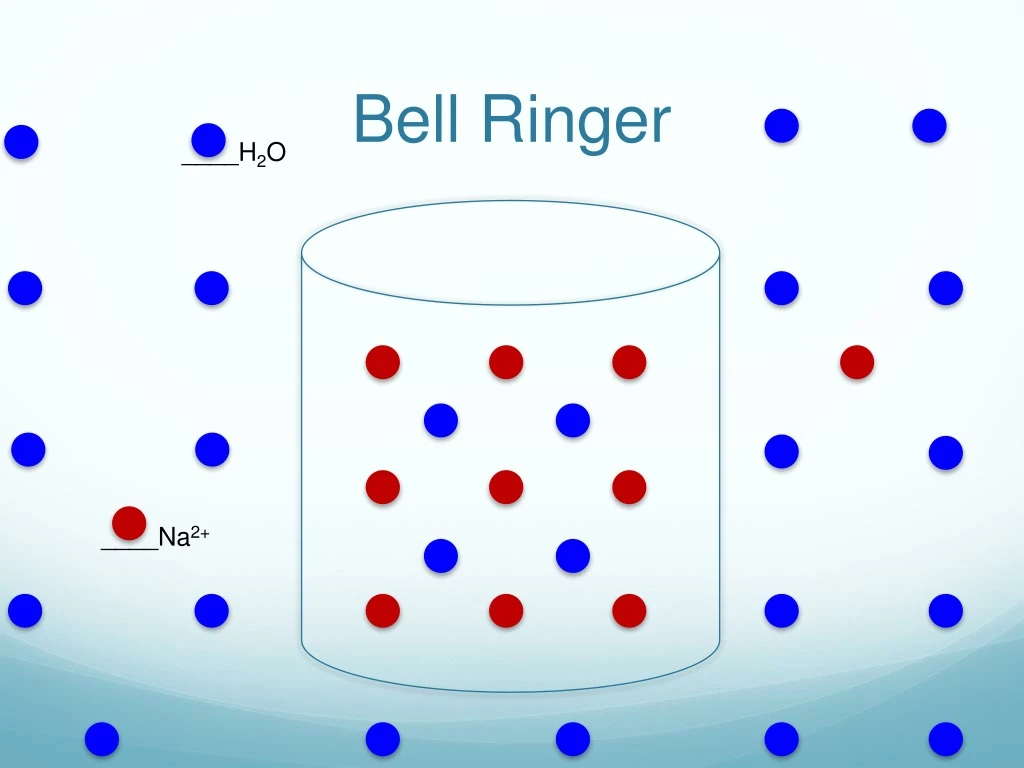
Bell Ringer ____H2O ____Na2+
Fluid Mosaic Model • Cell membrane is thought to be both fluid and a mosaic of phospholipids, proteins and carbohydrates. • Fluid material is capable of flowing, changing shape, and shifting • Mosaic small parts; together form a picture • https://www.youtube.com/watch?v=LKN5sq5dtW4
What is special about FMM? • Accounts for movement of molecules across the membrane
Cell Membrane Players • Phospholipids • Transport proteins • Carrier proteins • Channel proteins (aka. ion channel) • Receptor proteins • Marker proteins • Cholesterol
1. Phospholipids • Consists of: • Phosphate group (polar head) • Glycerol Backbone • Two fatty acids (nonpolar tail)
All Proteins • Molecule must fit inside protein in order to permeate the membrane 1. Transport proteins 2. Receptor proteins 3. Marker proteins • How are these proteins similar to enzymes? • How are these proteins different fromenzymes?
1.Transport Proteins a. Carrier proteins Function- move MOLECULES across a membrane Ex. hemoglobin, glucose transporter b. Channel proteins Function-move IONS across the membrane Ex. Potassium channel • move molecules or ions across a membrane DOWN their concentration gradient.
a. CarrierProteins Example 1: hemoglobin transfers O2
a. Carrier Protein Example 2: Glucose Transporter transports sugar
b. Channel Protein Potassium ions are flowing DOWN their concentration gradient K+ K+ K+ K+ K+ K+ K+ K+
Passive Transport (3) • Simple Diffusion • Molecules move from a high to low concentration • Osmosis • Movement of water from high to low concentration • Facilitated diffusion • Movement of molecules and ions from a high to low concentration with the help of: • Transport proteins- carrier proteins and channel proteins http://highered.mheducation.com/sites/9834092339/student_view0/chapter5/how_facilitated_diffusion_works.html
2. Receptor Proteins • Receptor Proteins- bind to a specific signal molecule, enabling the cell to respond • Function- cell to cell communication to perform action Example: rhodopsin detects light, enabling you to see in dim- light conditions.
3. Marker Proteins • Marker Proteins- distinguish cell type; “tags” it • Function: helps cells identify other cells • Example: MHC class I and II
Cholesterol • Cholesterol- type of fatty acid present in the cell membrane of all cells • Function: building block to make hormones, vitamin D and other substances that help you absorb nutrients from food you eat.
Lipoproteins: carry cholesterol throughout body • HDL- High Density Lipoproteins • AKA “good cholesterol” • Carries cholesterol back to liver to remove it. For You Information (NOT ON TEST) • LDL- Low Density Lipoproteins • AKA “bad cholesterol” • High levels of LDL means cholesterol builds up in arteries, making heart work harder than it needs to.
Animations For all cell membrane activities… visit the following website: http://www.town.hull.ma.us/public_documents/hullma_highschclass/Blair/Cell%20Membrane • Diffusion • Osmosis • Passive Transport • Facilitated Diffusion • Active Transport