Transforming Mathematics Education: Addressing Myths and Enhancing Teacher Efficacy
This paper explores critical issues in mathematics education, targeting the perceptions and experiences of young children and their teachers. Various beliefs about math, such as gender stereotypes and the impact of anxiety on teaching efficacy, are examined. The discussion highlights the need for teachers to unlearn harmful myths surrounding math, improve instructional quality, and foster a positive attitude towards math in students. Recommendations for teacher training and curriculum reform are provided to ensure that future educators can effectively engage students in mathematics.

Transforming Mathematics Education: Addressing Myths and Enhancing Teacher Efficacy
E N D
Presentation Transcript
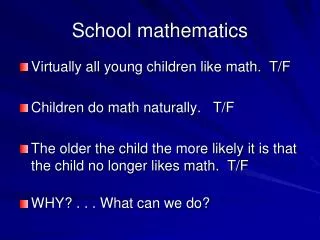
School mathematics • Virtually all young children like math. T/F • Children do math naturally. T/F • The older the child the more likely it is that the child no longer likes math. T/F • WHY? . . . What can we do?
Were your teachers prepared? Quality of Instruction “ I think that is right. Let me just check your answer.”
Have you ever had this teacher ? I asked you a question! What is 5/6 - 1/3 ? … and make that fast!
Your Math Anxiety & Your Ability to Teach Pre service teachers with the lowest degrees of mathematics anxiety had the highest levels of mathematics teacher efficacy. • Swars, Susan."The Relationship of Mathematics Anxiety of Elementary Preservice Teachers with Mathematics Teacher Efficacy" Paper presented at the annual meeting of the North American Chapter of the International Group for the Psychology of Mathematics Education, Hosted by Virginia Tech University Hotel Roanoke & Conference Center, Roanoke, VA, Oct 20, 2005 <Not Available>. 2009-05-25 <http://www.allacademic.com/meta/p19887_index.html>
The problem with math? Skills . . . With no reason Fractions . . . Withno understanding. Timed tests Lots of tests And teachers . . .
What are these triangles about ? We will be learning math differently than how you were taught
? ? ? ? ? What will U have 2 do so U can say:
Unlearn the “Math Myths”Preis & Biggs (2001) • Women can’t do math. • Some people can do math, others can’t. • My father/mother couldn’t do math, either. • I’m good at English, that’s why I’m so bad at math. • Insights into math have to come to you instantly. • If you can’t solve a problem immediately, you should just quit. • Aptitude is far more important than effort.
Learn Math and learn it deeply! --Fill in your missing math skills and concepts. --Learn lots of correct explanations. --Learn how to direct student thinking. --Learn how to demonstrate, how to lead students to the truth . . . without pain!
Learning Style Interpretation • http://www.calstatela.edu/faculty/jshindl/plsi/16types.htm • From I. Briggs-Myers & M. McCaulley (1992) Manual a Guide to the Development and Use of the Myers-Briggs Type Indicator. Consulting Psychologists Press