Download
1 / 4
40 likes | 150 Vues
This report outlines the third attempt at developing an 8-inch Na2KSb photocathode within a sealed test chamber achieving a base vacuum of <10^-9 Torr. The cathode was fully baked at 375°C for 24 hours, with rigorous RGA monitoring throughout the process. The new approach considers improved cleaning techniques, including oxygen plasma treatment, and highlights challenges faced, such as surface contamination impacting quantum efficiency (QE) measures. Future plans involve refining the deposition process and utilizing larger alkali sources to enhance performance.

E N D
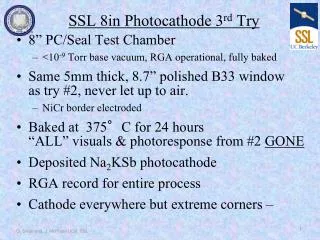
SSL 8in Photocathode 3rd Try • 8” PC/Seal Test Chamber • <10-9Torr base vacuum, RGA operational, fully baked • Same 5mm thick, 8.7” polished B33 windowas try #2, never let up to air. • NiCr border electroded • Baked at 375°C for 24 hours“ALL” visuals & photoresponse from #2 GONE • Deposited Na2KSb photocathode • RGA record for entire process • Cathode everywhere but extreme corners –
8” -Na2KSb bialkali 3rd Process 1.09 0.91 0.94 0.88 0.85 0.82 1.15 0.94 1.00 0.88 1.09 0.91 0.79 0.88 1.00 0.97 1.27 Somewhat too blue, but was ashort process, only 2 KSb cycles. Can add cycles next shot.Same window as #2 – still have surface contamination so next day QE was degraded. Uniformity much better than before. Generally ±15%.QE curve was measured at the upper right where it is ~0.9 (relative).
8” Na2KSb Process #2 - Comparison 0.85 0.64 0.58 0.55 1.06 0.96 0.61 0.50 0.98 #2A Cathode 2A was very blue, and decayedduring deposition process – indicative of possible window contamination. Uniformity measurementsworse in middle and corners.
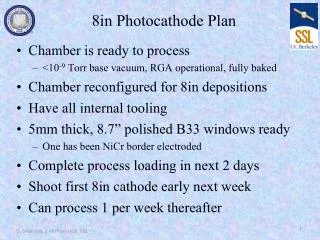
8in Photocathode Plan • Prepare new windows. • Optimize cleaning processes and use oxygen plasma clean as last step (have run sample tests last week to verify). • Deposit electrode with “X” conductor across the diagonals (tooling ready). • Use larger 40mm alkali sources. • Can shoot 3 or 4 cathodes in one pumpdown using Alkali/Sb materials, and employing high temperature vacuum bakes between.