Geographical Themes
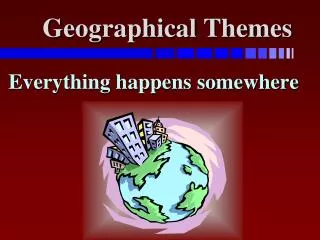
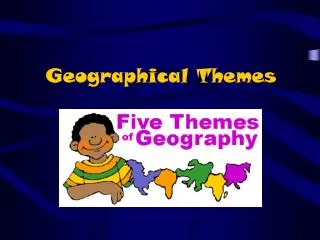
The Five Themes of Geography provide a framework for understanding the world around us. Location refers to both absolute and relative positions on Earth, using latitude and longitude or directional terms. Place highlights the unique physical and human characteristics of locales, including culture and climate. Human-Environment Interaction explores how people adapt to, modify, and depend on their surroundings. Movement focuses on the flow of people, goods, and ideas, while Regions categorize areas based on common features, forming and changing over time.

Geographical Themes
E N D
Presentation Transcript
THE FIVE THEMES OF GEOGRAPHY Location Place Human-Environment Interaction Movement Regions
Theme 1: Location Location: the meaning of relative and absolute position on the earth's surface • Sample terms: Latitude and longitude, site and situation, direction, distance, scale
Location • Two Types of Location • Absolute • Relative • Where is It? • Why is It There?
Absolute Location • A specific place on the Earth’s surface • Uses a grid system • Latitude and longitude • A global address
Absolute Location • Examples: • Rome is located at 41 N, 12 E • Argentina is located in the southern hemisphere • Ecuador is located in Tropic of Cancer. • LNE is located in Lincoln, NE.
Relative Location • Where a place is in relation to another place • Uses directional words to describe • Cardinal and intermediate directions
Relative Location • Examples: • Rome is located near the Mediterranean Sea. • Argentina is near Brazil. • Ecuador is south of Mexico. • Lincoln is 50 miles from Omaha.
Theme 2: Place Place: the distinctive and distinguishing physical and human characteristics of locales • Sample terms: Physical and cultural landscapes, sense of place
PlacePhysical Characteristics • Land Features • Mountains, plains, and plateaus • Climate • Bodies of Water
PlaceHuman Characteristics • People • Culture • Language • Religion • Buildings and Landmarks • Cities
Theme 3: Human Environment Interaction Relationships within places: the development and consequences of human-environment relationships • Sample terms: Ecosystems, natural resources, environmental pollution
Theme 3: Human Environment Interaction How People Interact With Their Environment People . . . • Adapt to Their Environment • Modify Their Environment • Depend on Their Environment http://www.fotosearch.com/comp/corbis/DGT119/BAG0017.jpg
Theme 4: Movement Movement: patterns and change in human spatial interaction on the earth • Sample terms: Migration, diffusion, globalization
Theme 4: Movement The Mobility of • People • Goods • Ideas How Places are linked to one another and the world
Regions: how they form and change • Sample terms: Formal vs. functional regions
Theme 5: Regions What Places Have in Common • Political Regions • Landform Regions • Agricultural Regions • Cultural Regions
Remembering the 5 themes • If you can’t remembering what they are just ask MR. HELP!!! • M – Movement • R – Regions • HE – Human Environment interaction • L – Location • P - Place