
Understanding Lipids: Their Role and Functions in Biological Systems

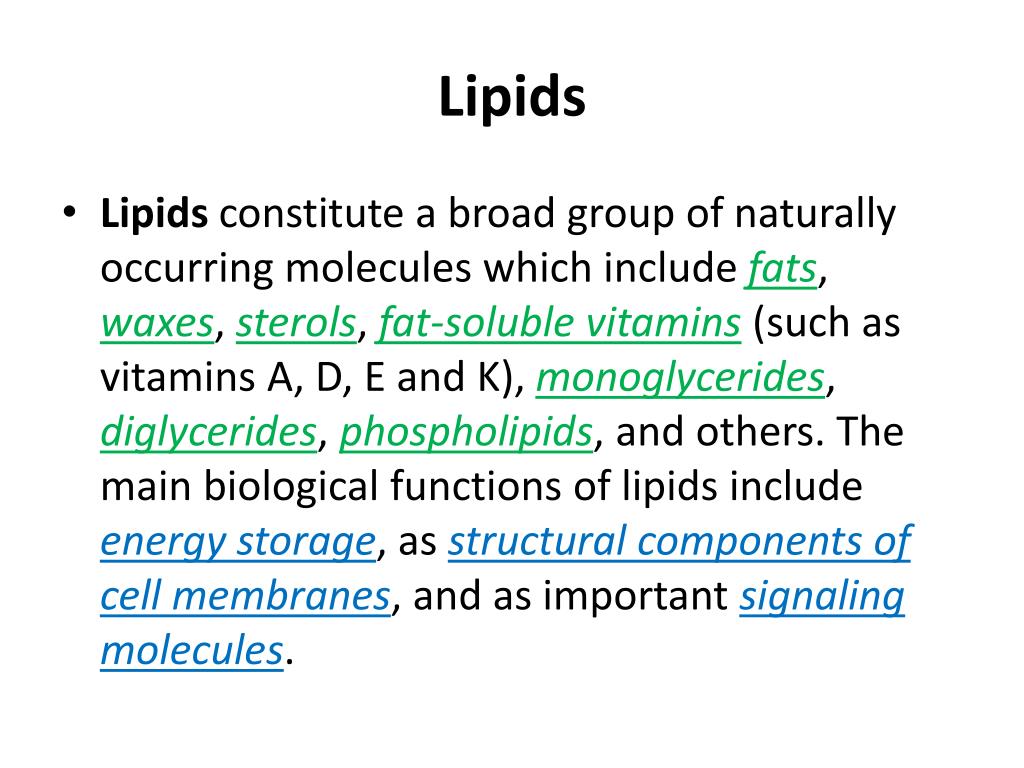
Lipids are a diverse group of naturally occurring molecules that encompass fats, waxes, sterols, and fat-soluble vitamins such as A, D, E, and K, along with monoglycerides, diglycerides, and phospholipids. These molecules play crucial roles in biological systems, including energy storage, serving as structural components of cell membranes, and functioning as important signaling molecules. Understanding the classification and functions of lipids is essential for studying metabolism and cellular processes.
Télécharger la présentation 
Politique de téléchargement : le contenu du site vous est fourni TEL QUEL pour votre information et votre usage personnel ; il ne peut être vendu, concédé sous licence ni partagé sur d’autres sites sans l’accord de son auteur.Le contenu vous est fourni TEL QUEL, pour votre information et votre usage personnel uniquement. Téléchargez la présentation en cliquant sur ce lien. Lors du téléchargement, si vous ne parvenez pas à télécharger une présentation, l’éditeur a peut-être supprimé le fichier de son serveur.Pendant le téléchargement, si vous ne parvenez pas à obtenir une présentation, le fichier a peut-être été supprimé par l’éditeur.
F I N