

SlideServe
Menu
Préférences
© SlideServe · v2026

Art Detective

lorin avatar
5 diapositives · 430 Views · Oct 10, 2014

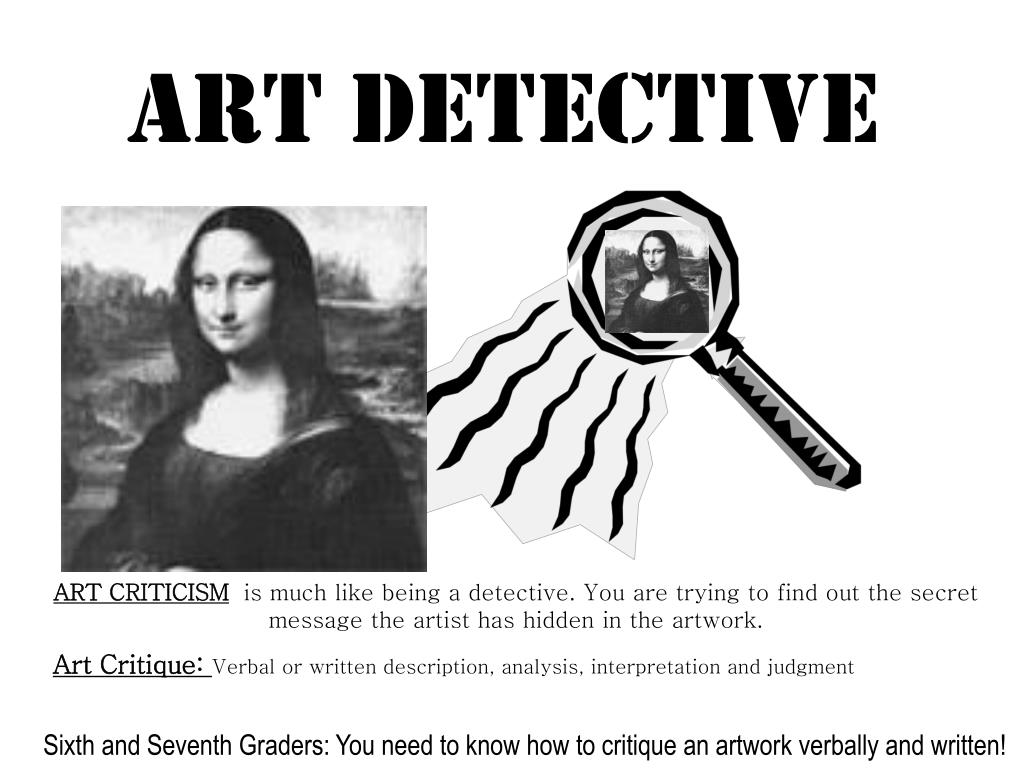
Art Detective. ART CRITICISM is much like being a detective. You are trying to find out the secret message the artist has hidden in the artwork. Art Critique: Verbal or written description, analysis, interpretation and judgment.
Art Detective - slide 1
01 / 5Art Detective
1 / 17

Télécharger la présentation

Art Detective
Une image / un lien ci-dessous est fourni (tel quel) pour télécharger la présentation

Politique de téléchargement : le contenu du site vous est fourni TEL QUEL pour votre information et votre usage personnel ; il ne peut être vendu, concédé sous licence ni partagé sur d’autres sites sans l’accord de son auteur.Le contenu vous est fourni TEL QUEL, pour votre information et votre usage personnel uniquement. Téléchargez la présentation en cliquant sur ce lien. Lors du téléchargement, si vous ne parvenez pas à télécharger une présentation, l’éditeur a peut-être supprimé le fichier de son serveur.Pendant le téléchargement, si vous ne parvenez pas à obtenir une présentation, le fichier a peut-être été supprimé par l’éditeur.

F I N

Plus de contenu associé

Transcription de la présentation
  1. Art Detective ART CRITICISMis much like being a detective. You are trying to find out the secret message the artist has hidden in the artwork. Art Critique: Verbal or written description, analysis, interpretation and judgment Sixth and Seventh Graders: You need to know how to critique an artwork verbally and written!

  2. A description is a statement that creates a mental image of something. State only facts! In a critique, describe the work of art to someone as if they had never seen it before. Make sure you refer to the Elements of Design - Value* Shape * Form * Color * Space *Texture * Line * Description • Things like…. • Subject of the artwork • Objects in the painting. • First impression. Note the characteristics of the artwork that first jump out at you. • Colors used. • Shapes, lines and texture. • Value – where you see light/darks • Space - what is in the fore/middle and background • Sensory qualities. Identify the predominant mood and visual effect. • Location

  3. Analysis It answers the question, "How did the artist do it?" Analyzing a work of art tells about the how the artist has used the Elements of Design. State only facts! Make sure you refer to the Principles of Design- Balance *Contrast * Emphasis * Movement* Pattern * • And how it applies to … • Color. • Shapes. • Forms. • lines. • Texture. • Light and shadow. (value.)

  4. Interpretation Based on what you have learned so far about the artwork…. • What do you think the artist was trying to say? • Why did the artist create this artwork? • What do you think it means? • What feelings do you have when looking at this artwork? • Do you think there are things in the artwork that represent other things - symbols?

  5. Judgment • Do you like this artwork? • Do you think it is a good artwork? • Do think it is an important artwork? • Would display this artwork in your home? • Is this artwork good enough to put in a museum? Justify your opinion. Explain why you feel the way you do about this artwork based on what you have learned about it.