Comparison of Breath Alcohol Testing Machines Using 2-Way Mixed Effects ANOVA
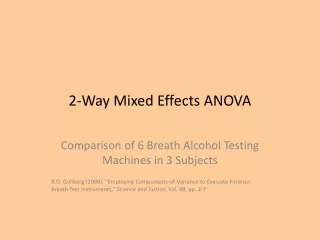
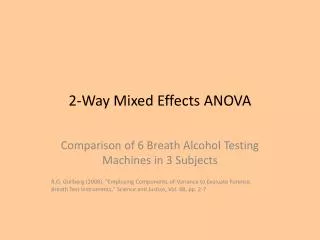
This study aims to evaluate the accuracy and reliability of six different breath alcohol testing machines by employing a 2-way mixed effects ANOVA. Conducted with three subjects, each machine underwent ten measurements, allowing for a comprehensive analysis of variance. Factor A represents the machines (fixed factor) with six levels, while Factor B pertains to the subjects (random factor) with three levels. The primary response variable is Blood Alcohol Concentration (BAC), with a legal limit of 0.08. This rigorous statistical analysis helps in understanding and comparing the effectiveness of forensic breath test instruments.

Comparison of Breath Alcohol Testing Machines Using 2-Way Mixed Effects ANOVA
E N D
Presentation Transcript
2-Way Mixed Effects ANOVA Comparison of 6 Breath Alcohol Testing Machines in 3 Subjects R.G. Gullberg (2008). "Employing Components-of-Variance to Evaluate Forensic Breath Test Instruments," Science and Justice, Vol. 48, pp. 2-7
Data Description and Statistical Model • Experiment was conducted to compare 6 breath alcohol machines in 3 subjects, with 10 measurements per subject per machine • Factor A – Machine with 6 Levels (Fixed Factor) • Factor B – Subject with 3 Levels (Random Factor) • Response – Blood Alcohol Concentration - 0.08=Legal Limit