Understanding Key Vocabulary: Manipulate, Examine, Ominous, and More
This resource delves into essential vocabulary, exploring words like "manipulate," which means to influence or control for personal advantage, and "examine," referring to careful scrutiny. We also cover "ominous," indicative of impending negativity, alongside terms like "impulse," "audibly," and more. The meanings, origins, and usage of these words are presented clearly, making this an invaluable tool for students and language enthusiasts alike to enhance their understanding of complex vocabulary.

Understanding Key Vocabulary: Manipulate, Examine, Ominous, and More
E N D
Presentation Transcript
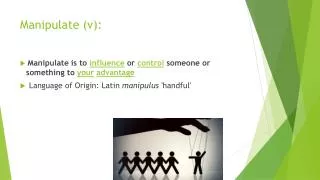
Manipulate (v): • Manipulate is toinfluence or control someone or something to youradvantage • Language of Origin: Latin manipulus 'handful'
Manipulate (v) • The editorial was a blatant attempt to manipulate public opinion. • She knows how to manipulate her parents to get what she wants.
Examine (v) • To look at someone or something very carefully; to study • Language of Origin: Middle English
Examine (v) • An accountant has been hired to examine the company's books. • The police examined the evidence carefully.
Ominous (adj) • Making you think something bad is going to happen • Language of origin: from Latin ominosus, from omen, omin- 'omen'.
Ominous (adj) • The black clouds looked ominous, so we paddled toward the shore. • He spoke in ominous tones.
Impulse (n) • A sudden feeling that you must do something, without thinking about the results. • Language or Origin: the verb from Latin impuls-
Impulse (n) • He has to learn to control his impulses. • Her first impulse was to run away.
Audibly (adv) • If something is audible, you can hear it • Language of origin: from late Latin audibilis, from audire 'hear'
Audibly (adv) • Speak audibly so all can hear. • The student sighed audibly.
Reluctantly (adv) • Not wanting to do something • Language of origin: from Latin reluctant
Reluctantly (adv) • Coach Elliott reluctantly chose Mrs. Chew as her assistant. • Colleen reluctantly agreed to the strapless purple bridesmaid’s dress.
Apprehensive (adj) • Feeling anxious about something that you are going to do • Language or origin: from French appréhensif or medieval Latin apprehensivus
Apprehensive (adj) • He’s a bit apprehensive about living away from home. • Many students and teachers feel apprehensive on the first day of school.
Peculiar (adj) • Strange, often in an unpleasant way • Language or origin: from Latin peculiaris of private property
Peculiar (adj) • Her accent was peculiar to the region. • The dog’s peculiar behavior worried them.
Scorn (n) • Harsh criticism that shows a lack of respect or approval for someone or something • Language of Origin: Middle English
Scorn (n) • They treated his suggestion with scorn. • She displayed a look of scorn on her face.
Perception (n) • The way you think about or understand someone or something • Language of origin: Latin
Perception (n) • The public perception of him as a hero is surprising. • We need to challenge many popular perceptions of old age.
Conscious (adj) • Awake and able to understand what is happening around you • Language of Origin: Latin conscius, from com- + scire to know
Conscious (adj) • He was fully conscious when we found him. • He was very conscious of his appearance.
Word Parts: • Manipulate • Mani (Latin) = hand • Impulse • Im (Latin) = without, not • Pul = urge • Conscious • Con (Latin) = with, jointly • Sci (Latin) = to know • Examine • Min (Latin) = small, less • Audibly • Aud (Latin) = hear • Reluctantly • Luct (Latin) = Struggle • Apprehensive • Prehens (Latin) = take, grasp