
SlideServe
Menu
Préférences
© SlideServe · v2026

Midbrain (mesencephalon)

lpeter avatar
26 diapositives · 1.5K Views · Jan 04, 2020

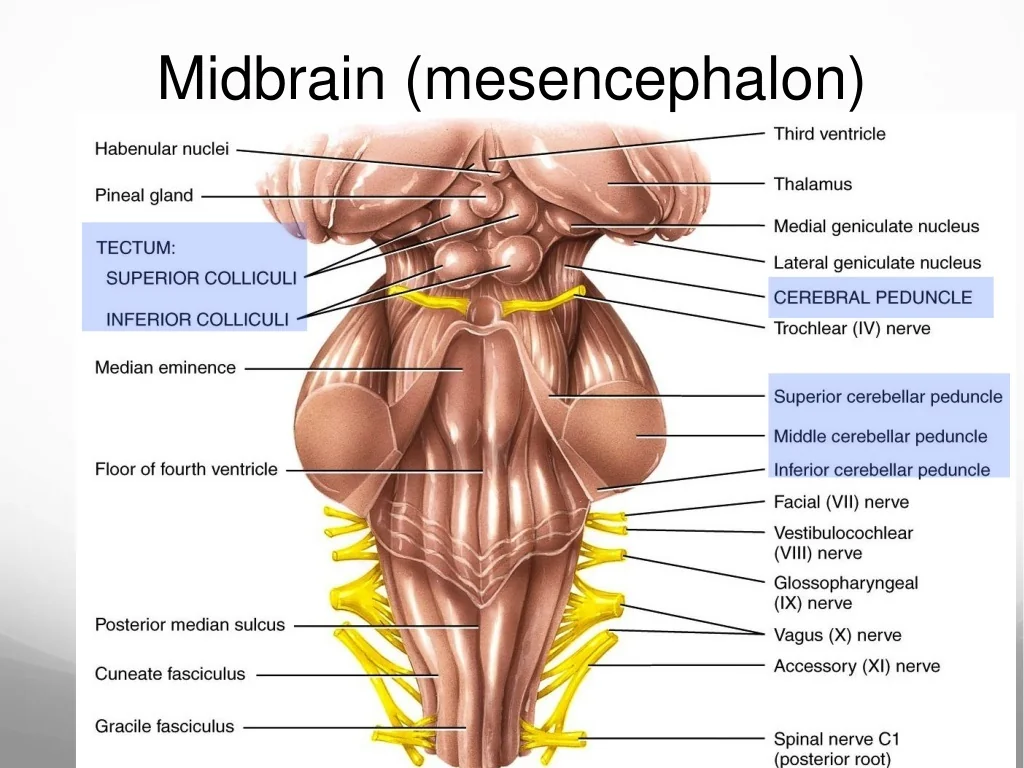
Midbrain (mesencephalon). Cerebellum. Subconscious skeletal muscle mvmt. Equilibrium and balance. Functions. Evaluate how cerebrum initiated movements are being executed Coordinates skeletal muscle contractions Posture & balance Cognition and language processing See table 14.2.
Midbrain  (mesencephalon) - slide 1
01 / 26Midbrain (mesencephalon)
1 / 17

Télécharger la présentation

Midbrain (mesencephalon)
Une image / un lien ci-dessous est fourni (tel quel) pour télécharger la présentation

Politique de téléchargement : le contenu du site vous est fourni TEL QUEL pour votre information et votre usage personnel ; il ne peut être vendu, concédé sous licence ni partagé sur d’autres sites sans l’accord de son auteur.Le contenu vous est fourni TEL QUEL, pour votre information et votre usage personnel uniquement. Téléchargez la présentation en cliquant sur ce lien. Lors du téléchargement, si vous ne parvenez pas à télécharger une présentation, l’éditeur a peut-être supprimé le fichier de son serveur.Pendant le téléchargement, si vous ne parvenez pas à obtenir une présentation, le fichier a peut-être été supprimé par l’éditeur.

F I N

Plus de contenu associé

Transcription de la présentation
  1. Midbrain (mesencephalon)

  2. Cerebellum Subconscious skeletal muscle mvmt

  3. Equilibrium and balance

  4. Functions • Evaluate how cerebrum initiated movements are being executed • Coordinates skeletal muscle contractions • Posture & balance • Cognition and language processing • See table 14.2

  5. Surrounds third ventricle Diencephalon

  6. Internal medullary lamina = • Y-shaped (white matter) • Divides lobes of gray matter Thalamus

  7. Hypothalamus Composed of a dozen nuclei REGULATES: • ANS activities • Production and release of hormones (oxytocin & ADH) • Emotional and behavioral patterns (with limbic system) • Feeding center, satiety center, thirst center • Body temperature • Circadian rhythms

  8. Epithalamus

  9. Cerebrum • Read, write, memory, imagine, emotions, math, music etc. • Gray matter / white matter

  10. Longitudinal fissure • Corpus callosum • 5 lobes CerebrumThe Seat of Intelligence

  11. Brain Lobes • Folded deep within lateral sulcus • Believed to play a role in emotion, consciousness and regulating homeostasis

  12. Corpus Callosum • Callosal commissure • Tough body • Broad band of nerve fibers • Hemispheric communication • Largest white matter area

  13. Cerebrum Functional AreasSensory, Motor, Association

  14. Cerebral Cortex

  15. Brain Folds of Cerebral Cortex • Gyri – convolutions • Sulci – shallow grooves • Fissures – deeper grooves • Longitudinal fissure (most prominent)  separates the cerebral hemispheres. • Falx cerebri  in the longitudinal fissure

  16. Cerebral White Matter • Connections between parts of brain and to rest of NS • Myelinated axons – 3 directions

  17. Cerebral White Matter • 3 types of fibers: • Association – gyri in same hemisphere • Commissural (3 groups) – corresponding gyri between hemispheres • Projection

  18. Cerebral White Matter • Commissural Fibers • Corpus Callosum – largest • Anterior Commissure • Posterior Commissure

  19. Projection fibers: • Internal Capsule thick band of white matter containing ascending and descending tracts • Runs through basal nuclei

  20. Basal Gangliaor Basal Nuclei • NOTE  no longer called ganglia b/c that is a group of cell bodies in the PNS. • 3 large nuclei deep within white matter • Globus pallidus • Putamen • Caudate nucleus

  21. Basal Nuclei (Ganglia) • Globus pallidus + putamen = lentiform nucleus • Lentiform nucleus + caudate nucleus = corpus striatum

  22. FUNCTIONS: • Initiate and terminate body movements • Suppress unwanted movements • Regulate muscle tone • Sensory, limbic, cognitive and linguistic functions

  23. Limbic System • Emotional Life, Memory, Motivation, Epinephrine (adrenaline) flow • CURRENT structures include: • Hippocampus – spatial memory and learning • Amygdala – Cognitive, emotional and social processes • Mammillary bodies of hypothalamus – limbic circuits • Olfactory bulbs • Fornix • Stria terminalis • Stria medullaris • Medial forebrain bundle • Mammillothalamis tract Linked by bundles of interconnected myelinated axons

  24. Limbic System