
SlideServe
Menu
Préférences
© SlideServe · v2026

Understanding Pressure: Definitions, Factors, and Applications in Physics

lsumner avatar
12 diapositives · 576 Views · Jan 03, 2020

Pressure is defined as the force applied against an obstacle distributed over a surface area, calculated using the formula P = F/A, where P is pressure, F is force, and A is area. This concept has practical implications in various situations, such as comparing the pressure exerted when wearing flat versus high-heeled shoes, or when standing versus lying down. Moreover, hydrostatic pressure in liquids is influenced by density and depth. Through solving several problems, we can better understand how area and force interact to affect pressure.
Understanding Pressure: Definitions, Factors, and Applications in Physics - slide 1
01 / 12Understanding Pressure: Definitions, Factors, and Applications in Physics
1 / 17

Télécharger la présentation

Understanding Pressure: Definitions, Factors, and Applications in Physics
Une image / un lien ci-dessous est fourni (tel quel) pour télécharger la présentation

Politique de téléchargement : le contenu du site vous est fourni TEL QUEL pour votre information et votre usage personnel ; il ne peut être vendu, concédé sous licence ni partagé sur d’autres sites sans l’accord de son auteur.Le contenu vous est fourni TEL QUEL, pour votre information et votre usage personnel uniquement. Téléchargez la présentation en cliquant sur ce lien. Lors du téléchargement, si vous ne parvenez pas à télécharger une présentation, l’éditeur a peut-être supprimé le fichier de son serveur.Pendant le téléchargement, si vous ne parvenez pas à obtenir une présentation, le fichier a peut-être été supprimé par l’éditeur.

F I N

Plus de contenu associé

Transcription de la présentation
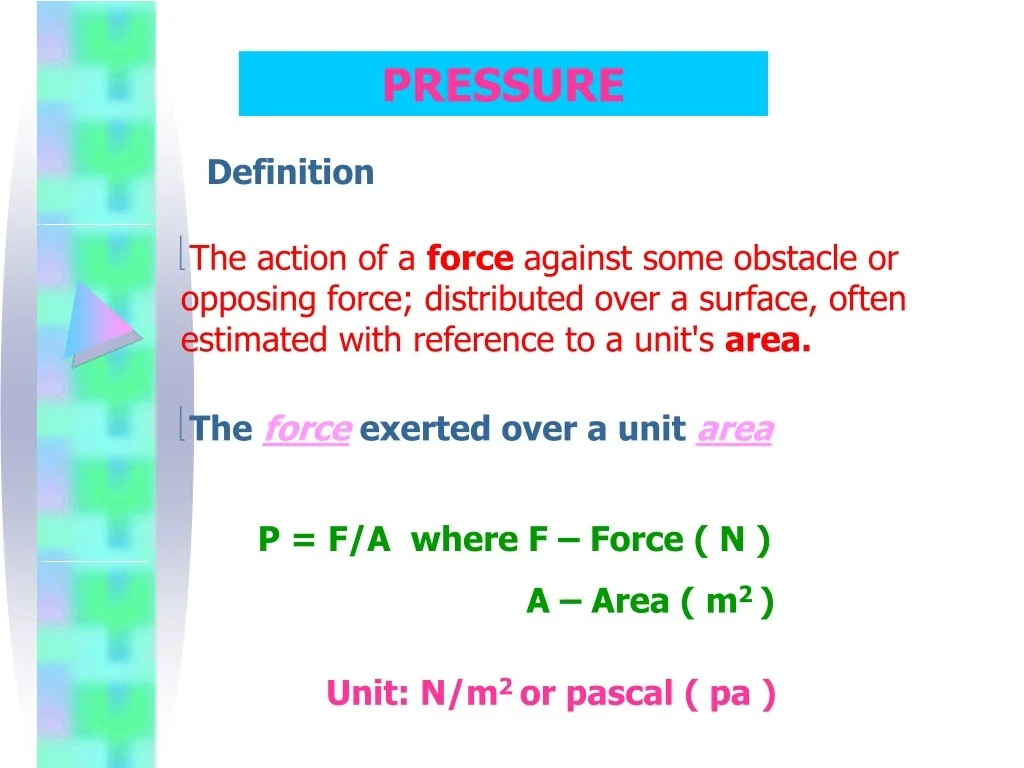
  1. PRESSURE Definition  The action of a force against some obstacle or opposing force; distributed over a surface, often estimated with reference to a unit's area.  The force exerted over a unit area P = F/A where F – Force ( N ) A – Area ( m2) Unit: N/m2or pascal ( pa )

  2. In which instance do you feel more pressure?  Wearing flat shoes vs Wearing high-heeled shoes

  3. Where do you exert more pressure?  Standing Position vs Lying down

  4. Which is easier to push?  Pushing a steel cabinet vs plastic cabinet

  5. Who will exert more pressure on the sofa bed?

  6. What are the factors affecting the amount of pressure? Area in contact with surface Weight of the body or Force Pressure is inversely proportional to Area Pressure is directly proportional to Force

  7. PROBLEM 1 A rectangular cabinet weighs 400N. It is 2 meters long, 1.5 meters wide and 0.5 meter thick. Find Pressure if a) the cabinet is lying on its base b) the cabinet is lying on its long side c) the cabinet is lying on its short side . In which side exerts the greatest pressure? Why?

  8. Problem 2 A man exerts a force equal to his weight on the ground where he stands on. If his weight is 500N & the area of his shoes is0 0.01 m2 then the pressure he exerts on the ground will be? If the man lies flat on the ground and area covered by his body is 0.2 m2 then find the pressure. In which case will pressure be greater? Why?

  9. Problem 3 An oxygen tank’s base is 20cm in radius, If the pressure exerted on its base is 50 pa then what is the weight of the oxygen tank? Given? Unknown?

  10. PRESSURE IN LIQUIDS Hydrostatic Pressurethis refers to the pressure exerted by the liquid. Factors to consider! Density Height or depth

  11. Pressure and Density A man dove 35 meters under the sea. If the seawater has a density of 1030 kg/m3. Find the pressure that acts on the man’s body? Suppose the man dove on a river, how much pressure will be exerted on his body? Given? Unknown?

  12. Where is it easier to swim, in the sea or in the river? Why? P = D x h x g Where is it easier to swim in deep waters or in shallow waters? Why? Pressure is directly proportional to Density Pressure is inversely proportional to Height