Shoreline Master Program Update: Planning Commission Meeting Overview (May 22, 2012)
During the Planning Commission meeting on May 22, 2012, key concepts and regulations concerning the Shoreline Master Program (SMP) were reviewed. The commission focused on Chapters 1-3, including the importance of public access, water-dependent uses, and ecological preservation. Participants were encouraged to listen, understand, and provide input on the draft SMP and upcoming schedule. Topics included environmental designations, vegetation conservation, and public access regulations, aimed at balancing development with environmental sustainability.

Shoreline Master Program Update: Planning Commission Meeting Overview (May 22, 2012)
E N D
Presentation Transcript
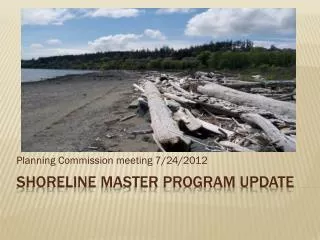
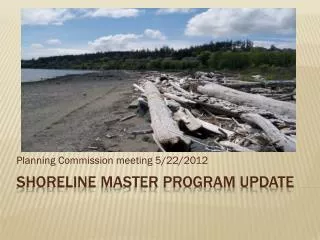
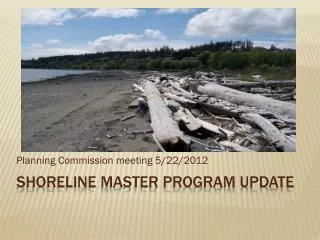
Planning Commission meeting 5/22/2012 Shoreline Master program update
Project Schedule • Planning Commission’s Role • Review Chapters 1 – 3 of Draft SMP • Focus is on understanding key concepts and regulations • Questions purpose
Listen • Understand • Ask questions • Make suggestions Pc role
May: Chapter 1 – 3 • June: Chapter 4 • July: Chapter 5 • August: Chapters 6 and 7 • Important point: DOE review still underway Schedule
SMA/SMP Purpose: (1) public access (2) water-dependent uses (3) environment Shoreline jurisdiction: 200 ft. + wetlands Ecology approval required No net loss of ecological functions Chapter 1: introduction
What are environment designations? State standard system. Chapter 2: environment designations
Key points: • Maritime: allows for industrial and commercial uses. • Allows for water-dependent industry (shipping, boat building, aquaculture, etc.) • Residential - Bluff Conservancy: appropriately sited development along bluff. • Generally more precise than existing designation • Planning Commission discussion? Chapter 2: environment designations
Applies to all areas w/i shoreline jurisdiction • Focus on key concepts: • Public access • Vegetation conservation • Mitigation sequencing • Other sections: • Econ. dev., archaeology, critical areas, environmental impacts & mitigation, etc. Chapter 3: general provisions
Public access: context • Hot topic with Shoreline Advisory Committee • One of three main SMA goals • Definition includes physical and visual access • Based on Public Trust Doctrine (PTD) • Putting access in perspective: most of OH shoreline already developed Chapter 3: general provisions
Public access: When is physical access required? • When development creates demand/need • SFR and subdivisions of four lots or less excluded • Public land or applicant is public agency • Interference with existing access Chapter 3: general provisions
Public access: When is physical access not required? • Safety hazards • Security of the use • Disproportionate cost • Environmental harm • Land use conflict w/ access (industrial?) Chapter 3: general provisions
Public access: Other key provisions (physical) • Adjacency to Waterfront Trail (regs. 3 & 8, pg. 31 & 32) • Fee in lieu (reg. 6, pg. 32) • Width: 12 ft. (reg. 18, pg. 33) • Design: (reg. 19, pg. 33) Chapter 3: general provisions
Public access: Key provisions (visual) • Views from public areas can be protected (reg. 20, pg. 33) • View study (reg. 21, pg. 33) • Reqs. of view study (reg. 22, pg. 33) • View mitigations (reg. 23, pg. 34) • Central point: balance private property rights with public interest. Committee struggled here. • Misconception: Either the view or the building Chapter 3: general provisions
Vegetation Conservation: context • Science: human and environmental benefits • Guidelines: conservation required. Prove no net loss. • Requirements: Based on Ecology experience and science on buffer width. • Ecology: prefer buffer and setback system. Buffers – 30 feet in urban setting. Chapter 3: general provisions
Alternatives: • Option A: Two Tier/Two Zone • Option B: Min/Max Setback • Option C: Standard setback Chapter 3: general provisions
Vegetation Conservation: Key Provisions • Zone 1: VMZ (buffer) – 0 - 30 feet wide (pg. 38 – 39) • Priority area for replacement and mitigation • Existing non-native vegetation can be maintained, not expanded • Pervious pathway 6 feet wide • Waterfront Trail improvements • 80% native vegetation required Chapter 3: general provisions
Vegetation Conservation: Key Provisions • Zone 2: setback – 30 - 50 ft (pg. 39) • New non-native allowed • Impervious limited to 20% • Water-oriented uses allowed (patios, decks, gazebos, boathouses, hot tubs) • Pervious pathway 6 feet wide • 60% native vegetation required Chapter 3: general provisions
Vegetation Conservation: (pg. 39-40) • Regulations triggered by new development exceeding 60% of assessed value • Shoreline landscape plan required • Requirement for plan may be waived if Zone 1 =80% native vegetation, Zone 2 = 60% native vegetation • Tree removal: significant trees – Zone 1 – 3:1, Zone 2 – 2:1, elsewhere 1:1 Chapter 3: general provisions
Environmental Impacts and Mitigation (pg. 27) • Mitigation sequencing • Avoid – don’t impact if you don’t have to • Minimize – avoid where possible • Rectify – rehabilitate impacted area • Reduce or eliminate – preserve or maintain over time • Compensation –replace function somewhere else • Monitoring – measure and take corrective measures Chapter 3: general provisions
![First Review of Preliminary Draft Shoreline Master Program [Entity] [Month Day, 2009]](https://cdn1.slideserve.com/2169369/slide1-dt.jpg)