Legos™ and Math: Exploring Isoperimetric Problems with Whales
Dive into the connection between Legos™ and mathematics by exploring the Whale Theorem, which focuses on finding the smallest perimeter enclosing a given area. Learn about Lego™ curves, perimeters, areas, and the innovative Hydropronic Sequence. Discover the mathematical beauty of maximizing area efficiency while minimizing perimeter, and delve into future work and references for further exploration in this fascinating field.

Legos™ and Math: Exploring Isoperimetric Problems with Whales
E N D
Presentation Transcript
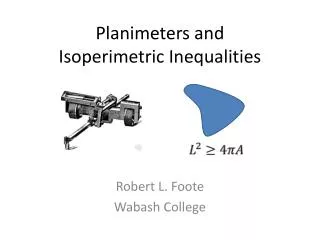
Block Isoperimetric problems What do math and Legos™ have in common? Whales.
Our Research Problem Using Legos™,what is the smallest perimeter that will enclose a given area?
Our Research Problem Background Information Whale Theorem Proof Hydropronic Sequence Future Work Historical motivation
Previous Work • Maximum area is always square or pronic. • Perimeter is always even. • Conclusion: A square or a square-like rectangle has the greatest amount of area.
Relations Between The Projects • They maximized area given a specified perimeter. We wanted to minimize perimeter given a specified area. • Research Question: Given a specified area, what is the most efficient way to enclose that given area?
Definitions! • Lego™ Curve: a single continuous arrangement of 1x1 blocks such that each block has exactly two neighbors. * • Neighbor: a block that occupies the space adjacent to another block in one of the four cardinal directions along the grid. * • * Referenced from work of: Bower, Espinoza, Green, Roca, and Townsend
Definitions! • Perimeter: the number of blocks used to create a Lego™ curve. (Reminder: Perimeters are always even) • Area: the number of studs enclosed by a Lego™ curve.
Our Research Problem Background Information Whale Theorem Proof Hydropronic Sequence Future Work Whale Theorem
The Whale Theorem Using Legos™, what is the smallest perimeter needed to enclose a specified area?
Our Research Problem Background Information Whale Theorem Proof Hydropronic Sequence Future Work Proof
Arrangement of Blocks Area: 45 Next Square or Pronic: 49
Arrangement of Blocks Area: 45 Next Square or Pronic: 49
Arrangement of Blocks Area: 45 Next Square or Pronic: 49
Arrangement of Blocks Area: 45 Next Square or Pronic: 49
Arrangement of Blocks Area: 45 Next Square or Pronic: 49
Arrangement of Blocks Area: 45 Next Square or Pronic: 49
Arrangement of Blocks Area: 45 Next Square or Pronic: 49
Arrangement of Blocks Area: 45 Next Square or Pronic: 49
Non Square & Non Pronic Formula • In order to find the next possible square or pronic use this formula: • Examples: • A = 8 • A = 2012
Examples • A = 8 • A = 2012
Graph of: Next Square or Pronic Desired Area to Enclose
Graph of: Area Perimeter
Our Research Problem Background Information Whale Theorem Proof Hydropronic Numbers Future Work HYDRoPRONIC Numbers
Hydropronic Numbers • A number that is not square or pronic and can be arranged as a rectangle using its two closest factors to maintain minimum perimeter. • 3, 8, 10, 15, 18, 21, 24, 28, 32, 35, 40, 45…etc
Hydropronic Numbers • Example: A = 24 • Factors: 1, 2, 3, 4, 6, 8, 12, 24 • Arrange a rectangle of 6 x 4
Hydropronic Area: 24 Hydropronic: 6 x 4 (24)
Whale Theorem Area: 24 Next Square or Pronic: 5 x 5 (25)
WhaLego Sequence • Numbers that can be arranged as rectangles and maintain the minimum perimeter are in the WhaLego sequence. All of these numbers can be classified as square, pronic, or hydropronic. • The first few numbers in this sequence are: 1, 2, 3, 4, 6, 8, 9, 10, 12, 15, 16, 18, 20, 21…etc
Our Research Problem Background Information Whale Theorem Proof Hydropronic Numbers Future Work Future work & References
Future Work • Furthering Hydropronic Sequence • Finding a generating formula • Lego Double Bubble Problem • Enclosing two areas • WhaLego sequence shows up • 3-Dimensional Spaces
References • Brower, T.; Espinoza, J.; Green, A.; Roca, A.; Townsend, B. LEGOTM Isoperimetric Problem, preprint (2010). • Capogna, L.; Donatella, D.; Pauls, S.; Tyson, J. An Introduction to the Heisenberg Group and the Sub-Riemannian Isoperimetric Problem, 1st ed., BirkhauserVerlag AG, Basel, Boston, 2007.
Questions? Special thanks to the National Science Foundation (DMS- 1005046), Dr. Casey Douglas, and the St. Mary’s College of Maryland Department of Mathematics and Computer Science.