SlideServe
Menu
Préférences
© SlideServe · v2026

Five Categories of Media

lucius avatar
16 diapositives · 343 Views · Oct 02, 2014

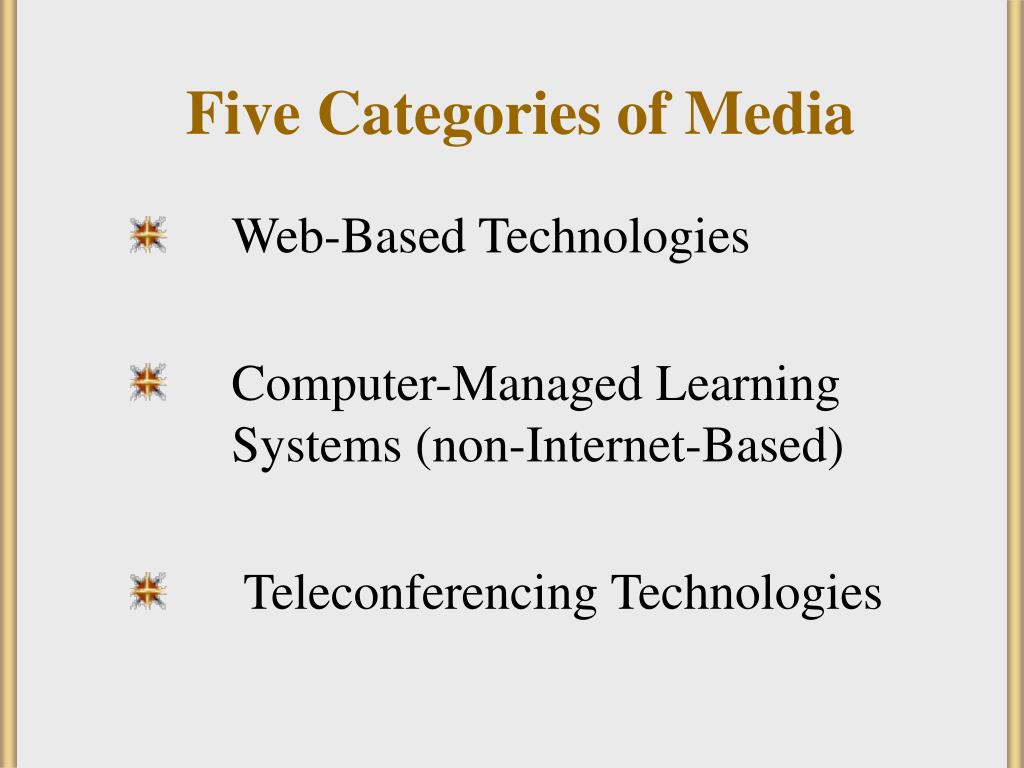
Five Categories of Media. Web-Based Technologies Computer-Managed Learning Systems (non-Internet-Based) Teleconferencing Technologies. Five Categories of Media (continued). Cable and Broadcast Television Videotaped-Based Instruction. Videotaped-Based Instruction.
Five Categories of Media - slide 1
01 / 16Five Categories of Media
1 / 17

Télécharger la présentation

Five Categories of Media
Une image / un lien ci-dessous est fourni (tel quel) pour télécharger la présentation

Politique de téléchargement : le contenu du site vous est fourni TEL QUEL pour votre information et votre usage personnel ; il ne peut être vendu, concédé sous licence ni partagé sur d’autres sites sans l’accord de son auteur.Le contenu vous est fourni TEL QUEL, pour votre information et votre usage personnel uniquement. Téléchargez la présentation en cliquant sur ce lien. Lors du téléchargement, si vous ne parvenez pas à télécharger une présentation, l’éditeur a peut-être supprimé le fichier de son serveur.Pendant le téléchargement, si vous ne parvenez pas à obtenir une présentation, le fichier a peut-être été supprimé par l’éditeur.

F I N

Plus de contenu associé

Transcription de la présentation
  1. Five Categories of Media • Web-Based Technologies • Computer-Managed Learning Systems (non-Internet-Based) • Teleconferencing Technologies

  2. Five Categories of Media (continued) • Cable and Broadcast Television • Videotaped-Based Instruction

  3. Videotaped-Based Instruction

  4. Videotaped-Based Instruction Refers to the use of videotaping equipment to produce staged or real-time learning opportunities. Videotapes are mailed to the participants and are viewed on a TV/VCR at his/her convenience. Videotaped-based instruction supports asynchronous communication between the presenter and the participants.

  5. Telephone, regular mail, fax, e-mail, and voice mail may be used in conjunction with videotaped-based instruction.

  6. Factors to Consider Advantages • Adapts to varied content areas • Provides convenience of use • Offers flexibility: portions of lectures or discussions may be replayed as needed • TV/VCR accessibility by most people in their homes

  7. Advantages(Continued) • Provides an inexpensive option (videotapes are inexpensive) • Captures attention and conveys a lot of information quickly • Easily duplicated

  8. Disadvantages • Provides no real-time interaction between presenter and participants • Promotes passive action on the part of participant • Limits cooperative learning between groups of participants • Videotapes wear quickly with continual use • Videotapes can be costly to send via regular mail

  9. Disadvantages (Continued) • Requires time to produce, as well as costly to revise and update • Participants may tend to feel isolated from others participating in the program unless provisions are made for them to interact with other participants • Recording may be complex

  10. Instructional Strategies for Incorporating Videotaped-Based Instruction

  11. Instructional Strategies Below is a listing of instructional strategies that may be supported by videotaped-based instruction. • Discussion • Lecture • Role-playing

  12. Instructional Strategies (Continued) • Presentation slides • Audio/visual materials • Demonstrations • Guest speaker • Self-directed learning • Self-instructional modules

  13. Instructional Strategies (Continued) • Facilitator demonstrations • Problem scenarios • Panel discussion • Videotaped field observations • Case problems • Tutorial assistance

  14. Technical Requirements • Requires participant to have access to a TV/VCR.

  15. Acknowledgement Sincere gratitude is expressed to Sabina Promesse, graduate assistant, Alabama A&M University, for assisting with information retrieval for this presentation.