
SlideServe
Menu
Préférences
© SlideServe · v2026

John Fowles (1926-2005)

luisa avatar
16 diapositives · 460 Views · Jul 31, 2014

John Fowles (1926-2005). (1963) The Collector (1964) The Aristos (1965) The Magus (revised 1977) (1969) The French Lieutenant's Woman (1973) Poems by John Fowles (1974) The Ebony Tower (1974) Shipwreck (1977) Daniel Martin (1978) Islands (1979) The Tree
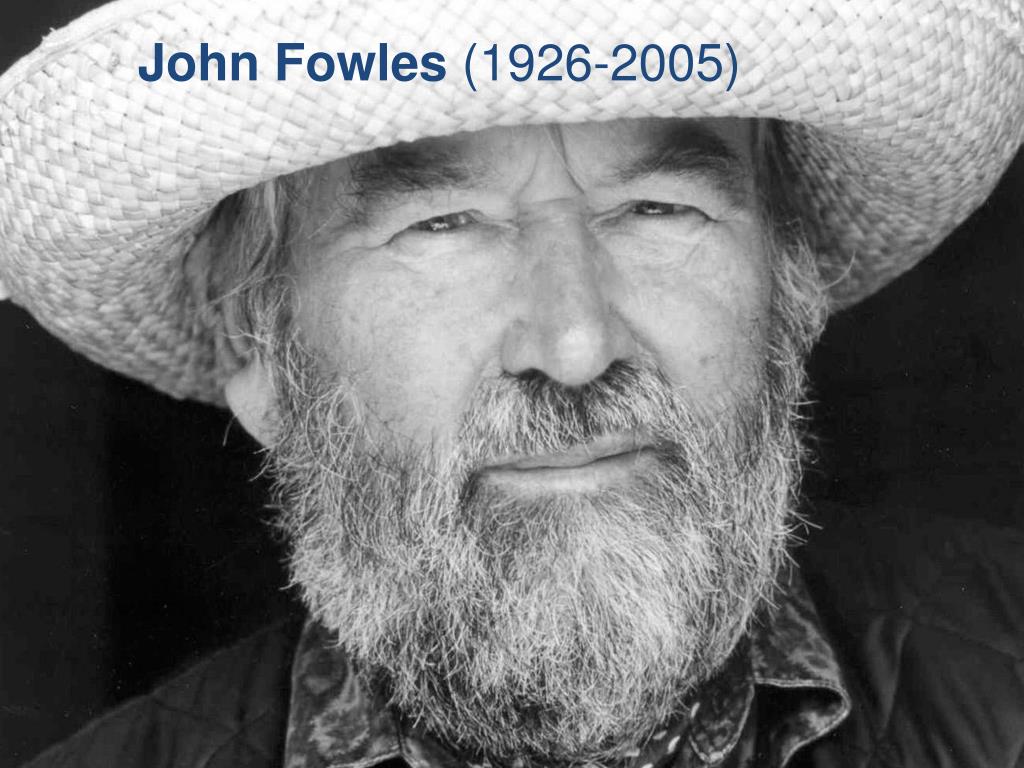
John Fowles (1926-2005) - slide 1
01 / 16John Fowles (1926-2005)
1 / 17

Télécharger la présentation

John Fowles (1926-2005)
Une image / un lien ci-dessous est fourni (tel quel) pour télécharger la présentation

Politique de téléchargement : le contenu du site vous est fourni TEL QUEL pour votre information et votre usage personnel ; il ne peut être vendu, concédé sous licence ni partagé sur d’autres sites sans l’accord de son auteur.Le contenu vous est fourni TEL QUEL, pour votre information et votre usage personnel uniquement. Téléchargez la présentation en cliquant sur ce lien. Lors du téléchargement, si vous ne parvenez pas à télécharger une présentation, l’éditeur a peut-être supprimé le fichier de son serveur.Pendant le téléchargement, si vous ne parvenez pas à obtenir une présentation, le fichier a peut-être été supprimé par l’éditeur.

F I N

Plus de contenu associé

Transcription de la présentation
  1. John Fowles (1926-2005)

  2. (1963) The Collector (1964) The Aristos (1965) The Magus (revised 1977) (1969) The French Lieutenant's Woman (1973) Poems by John Fowles (1974) The Ebony Tower (1974) Shipwreck (1977) Daniel Martin (1978) Islands (1979) The Tree (1980) The Enigma of Stonehenge (1982) A short history of Lyme Regis (1982) Mantissa (1985) A Maggot (1985) Land (with Fay Godwin) (1990) Lyme Regis Camera (1998) Wormholes - Essays and Occasional Writings (2003) The Journals - Volume 1 (2006) The Journals - Volume 2

  3. John Fowles(1926-2005) • born in 1926 in Leighton-on-Sea, Essex ”oppressively conformist family life” • educated at Oxford: French existentialism (Camus, Sartre) conformity and the will of the individual • 1950-63: teaching in France, Greece and in London • 1963: The Collector (success, earlier unfinished novels) • publishes fiction, poetry and essays regularly until 1990 • 1968: moves to Lyme Regis • http://www.fowlesbooks.com

  4. The Collector(1963) • lonely lower-class Ferdinand Clegg(butterfly collector) falls in lovewith higher middle-class arts student Miranda Grey, but unable to approach her • after winning a large sum, kidnapsher • love as total possession • first part: story in Clegg’s p. o. v.cold, emotionless languageClegg incapable of intimacy and normal human relationships • second part: Miranda’s diary • third part narrated by Clegg again

  5. The French Lieutenant’s Woman (1969) Characters: Charles Smithson (aristocrat) Tina (Ernestina) nouveau riche Sarah Woodruff Sam Farrow Mary Charles enjoys the company of his fiancée Ernestina in rural Lyme Regis, when he meets the outcast Sarah and finally falls in love with her.In the first version he returns to Ernestina. [First ending]However, it turns out to be a sort of daydreaming.

  6. He breaks up the engagement with Ernestina and returns to Sarah, who disappears. • A long search follows; Sarah finally found in the company of artists in London, with a daughter • Two alternative versions for and ending are offered: • Charles recognizes that Lalage is his own child, and a family reunion is implied[Second ending] • A bitter reunion: they meet and part again unhappily [Third ending]Reader to choose the appropriate ending (?)

  7. The French Lieutenant’s Woman (1969) • re/deconstruction of the Victorian novel (and society)narration: chronologicalvery detailed descriptions (dignified journalism?) • Victorian topics: • society (wide, many layers) • historical progress and social evolution (cf. Sam)[Dickens’s Sam Weller] • Victorian dilemma: rank marrying money • male hero facing decision: fair vs. dark lady[femme fatale] • Victorian omniscience (beginning: place, time, weather)

  8. Victorian novel with a modern consciousness praise and criticism of Victorian novel criticism of postmodernism (shallow, depthless) • Do we know the Victorians better? details vs. perspective / overall view (today?) • 1960’s: freedom decade, sexual revolution Isn’t freedom an illusion? Are we as free as we think? Aren’t we calculable?

  9. Attitude to history • looking for our problems in the historical context • creative anachronism • projection of a 1960s mentality into the 1860s • allusion to 20thcentury referents in 19thc. context • mostly remains at the level of the narrator’s discourse • (reference to television, Hitler) • foregrounding the temporal distance between the • act of narration and the objects narrated • but also penetrates the fictional world

  10. But exposing the gap between the date of the story and the date of its composition inevitably reveals not just the artificiality of historical fiction, but the artificiality of all fiction…. The French Lieutenant’s Woman is a novel as much about novel writing as about the past. There is a word for this kind of fiction, “Metafiction”… David Lodge, “A Sense of the Past” In: David Lodge, The Art of Fiction (1992)

  11. Chapter 13 – Metafiction”Who is Sarah?Out of what shadow does she come?” ”I do not know. This story I am telling is all imagination. These characters I create never existed outside my own mind. If I have pretended until now to know my characters’s minds and innermost thoughts, it is because I am writing in […] a convention universally accepted at the time of my story: that the novelist stands next to God.”

  12. authorial intrusion (also in Chapter 55): carefully created illusion broken author or narrator (or character)? essay or novel? (cf. Huxley) ”We know a world is an organism, not a machine. […] a planned world (a world that fully reveals its planning) is a dead world. It is only when our characters and events begin to disobey us that they begin to live. […] In other words, to be free myself, I must give him [Charles], and Tina, and Sarah, even the abominable Mrs. Poulteney, their freedoms as well. There is only one good definition of God: the freedom that allows other freedoms to exist.”

  13. autonomy / existential independence of the characters?basic features of the novel (character, author, ending) problematized • author as a modern (romantic) myth: the work of art stems in the authorThis myth questioned by Roland Barthes: ‘The Death of the Author’ (1968) Wimsatt and Beardsley: ‘The Intentional Fallacy’ (1946)Fowles: the unfreedom of the tyrantself-conscious author

  14. The freedom of the characters • The freedom of Sarah:you cannot know her, you cannot calculate her moves • explanations:quasi-religious: Mrs Poulteney (lapsed woman, fails second chance) scientific: Dr Grogan (Darwinist, agnostic) hysteria social: trying to rise at a high rank / fallen woman excludes herself from society Charles: no explanation: freedom (explain = control) I know a person = I can calculate his/her actions = predictability (power) threat of uncertainty: threat of freedom (cf. 1984)

  15. ”Fiction usually pretends to conform to the reality: the writer puts the conflicting wants in the ring and describes the fight – but in fact fixes the fight, letting that want he himself favours win. And we judge writers of fiction both by the skill they show in fixing the fights (in other words, in persuading us that they were not fixed) and by the kind of fighter they fix in favour of…” (Chapter 55) Endings: aleatoric principle John Cage: 4’33’’ (1952) also 0’0’’ (1962) also: chance procedures in other works

  16. the tyranny of the last chapter ” I take my purse from my pocket […], I extract a florin, I rest it on my right thumbnail, I flick it, spinning, two feet into the air and catch it in my left hand. So be it.” (Chapter 55)