SlideServe
Menu
Préférences
© SlideServe · v2026

Exploring Habitat Change: Understanding Student Ideas through Engaging Activities

luke-hubbard avatar
11 diapositives · 308 Views · Nov 15, 2014

This resource provides educators with practical strategies to help students understand the impact of habitat changes on wildlife. Through the “Four Corners” strategy, students discuss various hypotheses about the fate of the divos, enhancing their critical thinking skills. Activities like “Oh Gray Wolf!” and “Fun With Footprints” encourage exploration of essential survival needs for animals and creative problem-solving. Extensions include graphing and analyzing ecological data, fostering a deeper connection with environmental science concepts.
Exploring Habitat Change: Understanding Student Ideas through Engaging Activities - slide 1
01 / 11Exploring Habitat Change: Understanding Student Ideas through Engaging Activities
1 / 17

Télécharger la présentation

Exploring Habitat Change: Understanding Student Ideas through Engaging Activities
Une image / un lien ci-dessous est fourni (tel quel) pour télécharger la présentation

Politique de téléchargement : le contenu du site vous est fourni TEL QUEL pour votre information et votre usage personnel ; il ne peut être vendu, concédé sous licence ni partagé sur d’autres sites sans l’accord de son auteur.Le contenu vous est fourni TEL QUEL, pour votre information et votre usage personnel uniquement. Téléchargez la présentation en cliquant sur ce lien. Lors du téléchargement, si vous ne parvenez pas à télécharger une présentation, l’éditeur a peut-être supprimé le fichier de son serveur.Pendant le téléchargement, si vous ne parvenez pas à obtenir une présentation, le fichier a peut-être été supprimé par l’éditeur.

F I N

Plus de contenu associé

Transcription de la présentation
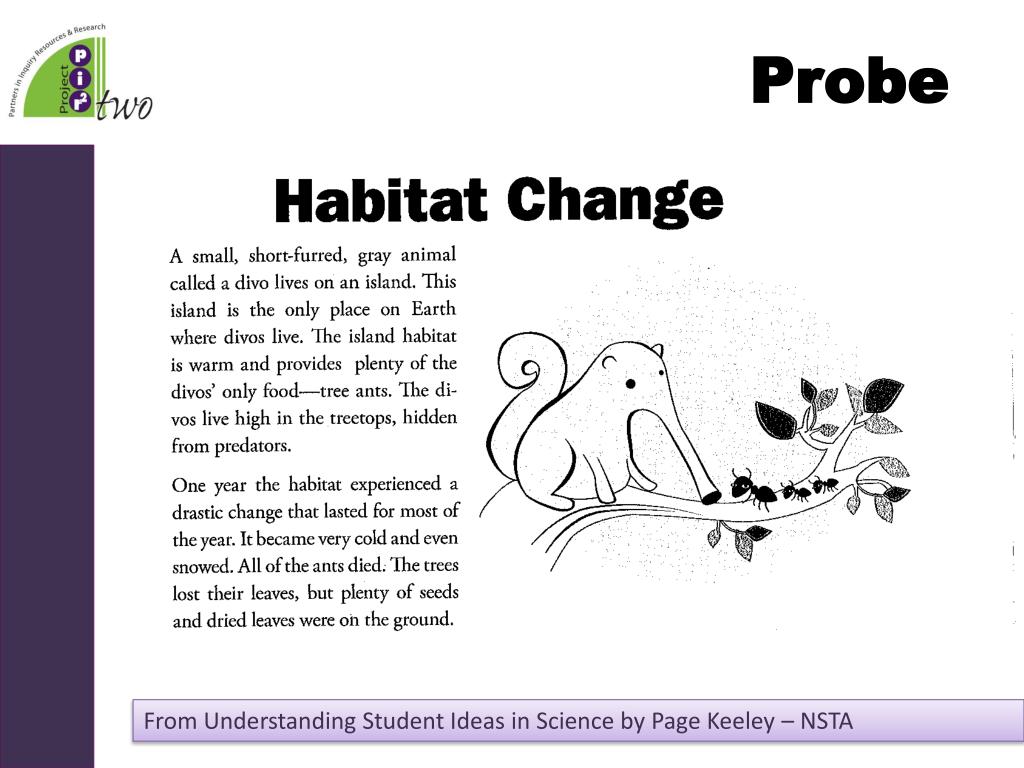
  1. Probe From Understanding Student Ideas in Science by Page Keeley – NSTA

  2. Q: What do you think happened to most of the divos living on the island after their habitat changed? • The divos’ fur grew longer and thicker. • The divos switched to eating seeds. • The divos hibernated through the cold period until the habitat was warm again. • The divos died.

  3. Strategy Four Corners Strategy • Write down your answer, and why you think so… • Go to the corner that matches your response • You have 5 minutes to discuss with your group why you think your corner is correct From Science Formative Assessment: 75 Practical Strategies… - Keeley

  4. Ideas for Modification of This Formative Assessment Timerhttp://classtools.net/education-games-php/timer/ • Use a timer to encourage sharing • Students can move if they change their minds after sharing • Modifications: • Debate from seats or in mixed groups • Eliminate the written answers • More or fewer corners (choices) A copy of the probe can be found at: http://srt3.atlantapublicschools.us/cms/lib/GA01000924/Centricity/ModuleInstance/22012/Habitat%20Change.pdf

  5. Oh Gray Wolf! Activity What do gray wolves need to survive? • Food (elk) • Water (Maumee River) • Shelter (Elm and Ash trees) Hands over head Hands on stomach Fingers to lips

  6. Oh Gray Wolf! Extension 1 • Graph it! See Oh Deer! Activity below for examples. • http://www.riverventure.org/charleston/resources/pdf/population%20study%20game.pdf • Or play the “Oh Deer!” game in addition (see above link).

  7. Oh, Gray Wolf! Extension 2 Video Resource The Story of the Great Black Swamp WBGU created a short film called “The Story of the Great Black Swamp.” This VHS be borrowed from both, or purchased on DVD from WBGU. Visit for a preview:http://wbgu.org/community/documentary/Story_GrBlack/Swamp_index.html • Toledo-Lucas County Public Library also has this available on VHS. • Discuss how this relates to the Black Swamp and the many organisms that were native to northwest Ohio and how that changed once it was drained… Why?

  8. Fun With Footprints Activity Position One Footprints Example This activity adapted from: Fossil Footprints - National Academy Press

  9. Positions One and Two Footprints Example

  10. All Three PositionsFootprints Example The idea is to use these as an example to create your own scenario for students to creatively problem solve with.

  11. Questions To Encourage Student Thinking Footprint Activity • Can you tell anything about the size, nature or kind of animals who made the tracks? • Were all the tracks made at the same time? • How many animals were involved? • Can you reconstruct a series of events represented by this set of tracks? See Animal Tracks Activity on the pi r2 website at nwocenter.org/pir2