Download
1 / 13
130 likes | 256 Vues
This presentation by Maxim Rapoport under the guidance of Dr. A. Zavaliangos explores advanced simulations of powder compaction in the pharmaceutical industry using ABAQUS software. The study investigates the distance between particles during compaction, addressing issues of contact detection and collision events. The findings reveal that the normal collision algorithm tends to overestimate contact in early stages, while the collision algorithm better indicates particle rearrangement. This research aims to improve algorithms for evaluating contact area and orientation in powder compact systems.

E N D
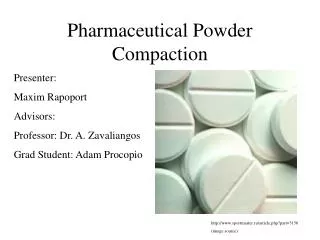
Pharmaceutical PowderCompaction Presenter: Maxim Rapoport Advisors: Professor: Dr. A. Zavaliangos Grad Student: Adam Procopio http://www.sportmaster.ru/article.php?part=3156 (image source)
INDUSTRIAL APPLICATION Porous Compact Powder
FINDING CONTACTin non-contactingbodies NO ZOOM 100x ZOOM
PARTICLE DISTANCE How to gauge distance between particles? ?
PROBLEM WITH NORMAL The P1 is a point in particle 1 P2 and P3 are point in particle 3 When normal is calculated P1 is very close to the line given by P2-P3 Contact is detected even though P1 is far from p1-p2 1 RESULT: overestimation at early stages 2 3
COLLISION Before After
RESULTS NORMAL COLLISION
Coordination Number 0 1 2 3 4 5 6 7 Snap shot-Last Stages Normal Collision
Coordination Number 0 1 2 3 4 5 6 7 Snap shot-Early Stages Collision Normal
ANALYSIS • Algorithms converge on late stages • Normal algorithm overestimates the number of contact in early stages • Collision algorithm makes rearrangement apparent
Current Work • Verification of correctness of algorithm • Using contact pairs to evaluate contact area and orientation