
SlideServe
Menu
Préférences
© SlideServe · v2026

Disaster Management Communication Services System

luyu avatar
16 diapositives · 275 Views · Sep 06, 2014

A domain-specific visual environment for modeling disaster management communication services with generative architecture for code generation. Allows developers to create, save, load, and execute communication schemas. Design methodology includes MDSD and meta-models. Software architecture features Pipe & Filter and Model-View-Controller patterns. UML profiles and class diagrams are utilized. Object interactions include State Machine and modeling behaviors.
Disaster Management Communication Services System - slide 1
01 / 16Disaster Management Communication Services System
1 / 17

Télécharger la présentation

Disaster Management Communication Services System
Une image / un lien ci-dessous est fourni (tel quel) pour télécharger la présentation

Politique de téléchargement : le contenu du site vous est fourni TEL QUEL pour votre information et votre usage personnel ; il ne peut être vendu, concédé sous licence ni partagé sur d’autres sites sans l’accord de son auteur.Le contenu vous est fourni TEL QUEL, pour votre information et votre usage personnel uniquement. Téléchargez la présentation en cliquant sur ce lien. Lors du téléchargement, si vous ne parvenez pas à télécharger une présentation, l’éditeur a peut-être supprimé le fichier de son serveur.Pendant le téléchargement, si vous ne parvenez pas à obtenir une présentation, le fichier a peut-être été supprimé par l’éditeur.

F I N

Plus de contenu associé

Transcription de la présentation
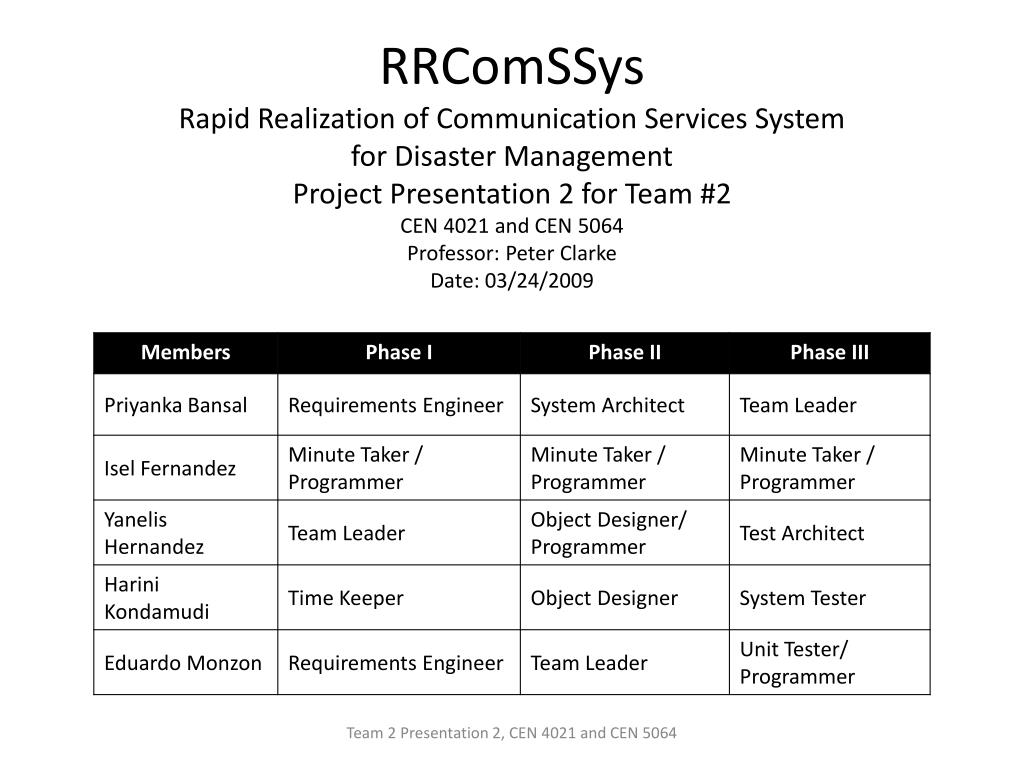
  1. RRComSSysRapid Realization of Communication Services Systemfor Disaster Management Project Presentation 2 for Team #2 CEN 4021 and CEN 5064Professor: Peter ClarkeDate: 03/24/2009 Team 2 Presentation 2, CEN 4021 and CEN 5064

  2. System Overview • Provides a domain-specific visual environment for the modeling of a Disaster Management communication service. • Allows the developer to capture relevant details from the customer before initiating the implementation. • Provides a generative architecture that will be transparent to developer. • Allows generating executable code from the communication schema specified. Team 2 Presentation 2, CEN 4021 and CEN 5064

  3. System Requirements (I) • The system shall allow developers to successfully log-in into the system • The system shall allow developers to successfully log-out of the system • The system shall allow developers to create two-way video schemas using a graphical modeling tool • The system shall allow developers to create three-way voice schemas using a graphical modeling tool • The system shall allow developers to create two-way chat schemas using a graphical modeling tool Team 2 Presentation 2, CEN 4021 and CEN 5064

  4. System Requirements (II) • The system shall allow developers to save communication schemas into the repository of models • The system shall allow users to load communication schemas from the repository of models • The system shall allow users to execute communication schemas by first transforming them into communication instances and validating them • The system shall allow developers to drop shapes in the process of creation of a communication model • The system shall allow developers to connect shapes in the process of creation of a communication model Team 2 Presentation 2, CEN 4021 and CEN 5064

  5. Design Methodology – MDSD Team 2 Presentation 2, CEN 4021 and CEN 5064

  6. Meta-model for CML - Communication Team 2 Presentation 2, CEN 4021 and CEN 5064

  7. Meta-model for CML - Workflow Team 2 Presentation 2, CEN 4021 and CEN 5064

  8. Software Architecture (I) • Pipe & Filter : Used in the modeling and code generation subsystems. • Classes involved in representing the G-CML and X-CML models are pipes. • Classes involved in doing the transformations of the XML files are filters. • Model View Controller : Used in the model execution subsystems. • Views are the multiple windows to enable the execution of a model • Model is the set of entities to represent the communication model. • Controller are the classes responsible for ensuring the flow of events. Team 2 Presentation 2, CEN 4021 and CEN 5064

  9. Software Architecture (2) Team 2 Presentation 2, CEN 4021 and CEN 5064

  10. UML Profile – Main Package Team 2 Presentation 2, CEN 4021 and CEN 5064

  11. Class Diagram – Main Package (I) Factory Method Command Team 2 Presentation 2, CEN 4021 and CEN 5064

  12. Class Diagram – Main Package (II) Singleton Team 2 Presentation 2, CEN 4021 and CEN 5064

  13. Object Interaction (I) – State Machine Team 2 Presentation 2, CEN 4021 and CEN 5064

  14. Object Interaction (2)-Drop and Connect Two Shapes Team 2 Presentation 2, CEN 4021 and CEN 5064

  15. Object Interaction (3) - Execute Model Team 2 Presentation 2, CEN 4021 and CEN 5064

  16. The End Thank you! Questions and Answers Team 2 Presentation 2, CEN 4021 and CEN 5064